The ‘Three-Day’ Special Military Operation
Russia's expectation of a quick fall of Kyiv fell apart under its own overconfidence and flawed planning, made worse by a military still built for an earlier kind of war.

FEBRUARY 24, 2022. The second strongest army and the third largest air force on the planet. A navy 4.7 times the size of Ukraine’s. Effective occupation of parts of Ukraine since 2014. Russia had clearly stacked the deck against Ukraine, and it appeared evident that Kyiv was fated to fall in weeks, if not days, were Russia to invade. However, this clearly did not come to pass. 1,500 days into the so-called “three-day special military operation”, Ukraine still stands, unbowed before what seemed an insurmountable threat.
Russia came into the war with tremendous arrogance. Russian planners expected total victory within 10 days with Lukashenko, the President of Belarus, even claiming it could be over within 3 or 4 days. This arrogance meant that Russia’s key push in the first few days of the conflict was a 35-mile long column heading straight for Kyiv, scarcely escorted by air defences, aiming to achieve a decisive victory in Kyiv and an effective decapitation of Ukrainian leadership in accordance with the previous 10-day plan.
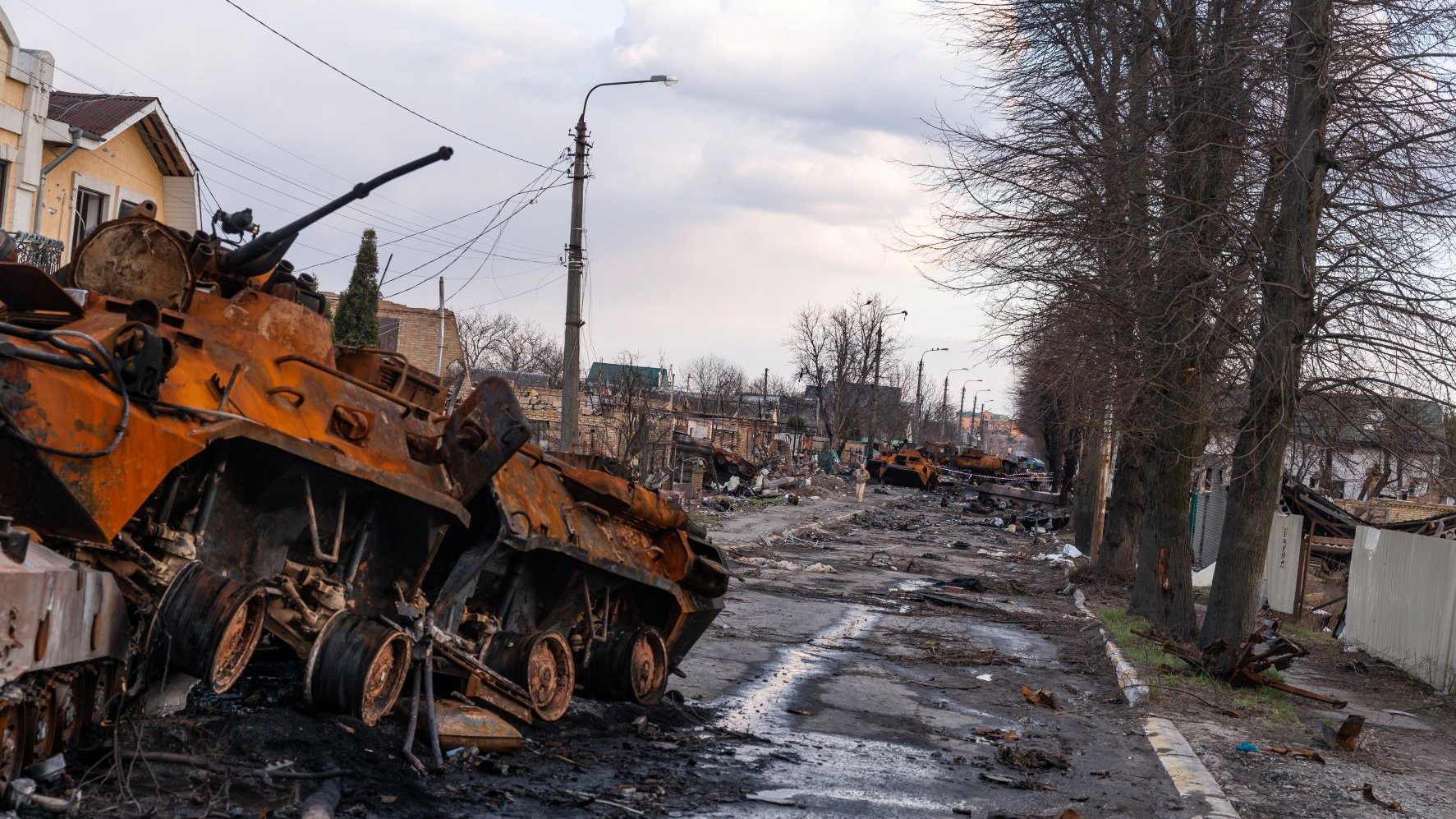
As expected, the convoy came under immediate opposition by Ukrainian air assets including TB-2 Bayraktars, Ukrainian Air Force jets and drones, which would eventually serve a crucial role in the war for both sides. Russian air defences proved ineffective with the vulnerable Ukrainian TB-2s not being shot down; rather, multiple Russian anti-air systems, along with some trucks and tanks, were eliminated.
In addition to aerial bombardment, the convoy also suffered significant casualties from Ukrainian ground forces armed with snipers and anti-tank guided missiles which the Russians had not anticipated due to insufficient intelligence, surveillance and reconnaissance. Maintenance problems also surfaced and many vehicles simply broke down along the road, allowing Ukrainian farmers with tractors to take them intact, repair them and donate them to the Armed Forces of Ukraine.
Finally, due to poor logistical planning, the convoy was entirely halted 8 days into the war due to fuel and food shortages about 30 km from Kyiv itself. By the end of March, the convoy turned around in retreat, having failed tactically and strategically and suffered heavy losses.
The other major arm of the Russian push to take the Ukrainian capital was headed by the Airborne Forces (VDV). However, due to these elite troops being dropped into Ukraine without support, they were decimated due to enemy anti-air fire. Within the first two months, the VDV dropped into Hostomel airport (10km northwest of Kyiv) twice in order to capture it as a forward airbase, being repelled by Ukrainian forces the first time and buying Ukrainian forces enough time to destroy the runway with artillery fire.
Another attempt to take Vasylkiv Air Base (30km south of Kyiv) also failed and left VDV troops encircled, beginning a pattern of VDV drops being less and less successful as the war went on. The disastrous result of these airborne assaults eventually convinced Russian high command to pause airborne operations and employ VDV forces as ground infantry, subjecting these elite forces to the atrocious casualty rates at the front.
The failure of Russian intelligence underpins these defeats: the Russians heavily underestimated the Ukrainians’ willingness to fight. They expected the Ukrainians to roll over like they had in 2014 when Russia occupied Crimea and planned their operation accordingly. Had they possessed better intelligence regarding Ukrainian resolve, they may not have invaded, as the cost of the war would far outweigh the gain obtained by Russia by invading.
Russian intelligence was also unable to accurately identify appropriate tactical targets in the opening stages; Russia lost precious precision munitions destroying unworthy targets like outhouses, decoys and defunct fighter aircraft rather than conducting a devastating first strike as intended.
To make things even worse for the troops on the ground, Russia also committed a major blunder with its procurement strategy – they spent significant funds on show-off wonder weapons like the Sarmat intercontinental ballistic missile and Poseidon nuclear torpedo, which could not be effectively deployed in conventional warfare. They also invested in overhauling the Russian Navy, most notably the ailing carrier Admiral Kuznetsov and Kirov-class Admiral Nakhimov, which were deeply impractical for Russia’s strategic aims.
This was partially a product of repeating the mistaken old Soviet strategy of attempting to match the US Navy on the seas, wasting valuable resources that could’ve been invested in upgrading existing army and air force equipment in order to maintain a strategically irrelevant navy.
All of this misdirected spending took up valuable roubles in the Russian defence budget, leading to cost cutting in one of the most underrated parts of a military: communications and optics. These elements may seem insignificant on paper but they can make or break military operations depending on their effectiveness.
The Russians relied on unsecured and unencrypted communications technology to send instructions to troops; thus, Ukrainian forces were able to intercept these communications and so were able to carry out ambushes with drones and small ground teams armed with ATGMs, causing major damage to armoured columns and blunting Russian offensives.
Poor Russian optics also contributed to Russian struggles with ambushes and drones, with reports of troops using iron sights (which have optical illusion and low precision issues) despite being in the comparatively elite invasion force, leaving them extremely vulnerable in the hours of darkness and in forested conditions. As a result, Ukrainian troops armed with proper night vision goggles and thermal vision gear were able to hit the Russians with comparative ease as the Russian forces were unable to target them despite their theoretically more powerful weaponry and numbers.
Another aspect of the Russian military handicapped by the spending on superweapons and a Potemkin navy was maintenance. Armies simply do not function if maintenance is poor and this has been a problem since WW2, with infamous stories of T-34s (the most abundant Soviet tank during WW2) often not even making it to the front lines.
In the early days of the invasion, there were many Russian vehicles breaking down and being abandoned despite being quite easily repairable, as demonstrated by the Ukrainians repairing them and subsequently using them against the Russians. Farmers armed with tractors were able to drag them away completely intact and, rather humorously, for a few weeks, Russia was the largest donor of heavy equipment to the AFU while Western aid was still stuck in bureaucracy.
Maintenance was an issue beyond just the land forces: 10 out of 181 total Russian fixed-wing losses were due to non-combat related crashes and there were many Russian missiles and guided bombs that either failed to get off the rail, dropped and didn’t explode or hit but missed their target in what could have been a crushing first strike, with USNI claiming a 20-60% failure rate for munitions across the Russian inventory in the initial phase of the war. In contrast, American munitions generally have a single-digit failure rate across all types.
Maintenance or rather, the lack thereof, was also a key contributor to one of the most shocking Ukrainian victories of the early war: the sinking of the Black Sea Fleet flagship, the cruiser Moskva with two Neptune cruise missiles. Having taken part in bombardments of civilian targets in the vicinity of Odessa, the ship was sailing 120 km south of Odessa when she was struck by 2 missiles and suffered heavy damage, eventually sinking on 14 April.
Afterwards, maintenance records of the Moskva, from two weeks before the invasion began, surfaced, painting an exceptionally bleak picture of the Moskva’s combat readiness. The Moskva’s air defence systems had been stood down prior to the attack due to interference with its communications, leaving the ship effectively blind to incoming missiles. Its shorter-range defence systems were entirely inoperative, and of its last line of defence against missiles, only one of six was functional and so the Neptunes were not intercepted in time.
The ship’s engines were well beyond their service life due to neglect, its watertight doors were open when the missiles struck, and barely one in seven fire extinguishers worked. Damage control was never a realistic prospect.
The training of all members of the Russian forces was also extremely lacking in comparison with Western forces. To start with the army, the soldiers involved in the invasion were entirely uninformed, with Russian operational security having hidden the plans from not just the Ukrainians, but their own soldiers as well. Despite the obvious complexity and difficulties of conducting such a massive invasion, the soldiers also received no specific training, resulting in chaos once the troops got there and realised they were way out of their depth.
Russian air defence crews were also poorly trained in identifying friend from foe, resulting in a notable number of their own and neutral aircraft being shot down by their own side. The Russian Aerospace Forces fared no better – they lacked training in the missions most critical to the invasion, particularly the suppression of Ukrainian air defences, which would have allowed Russian aircraft to operate freely over Ukrainian territory.
Having failed to neutralise Ukrainian air defences, Russian pilots were forced to fly low to avoid being shot down at altitude, exposing them instead to shoulder-fired missiles from the ground. Twenty fixed-wing aircraft were lost to enemy fire in the first month alone, a loss rate twelve times higher than the US-led coalition during the Gulf War.
The deeper problem was Russian military doctrine itself. The Russian army inherited a Soviet-era top-down structure in which ordinary soldiers are given little responsibility or initiative; decisions flow from officers, and troops are expected to follow rather than think. At the start of the invasion, this meant that when the convoy ran into trouble, the soldiers on the ground had neither the information nor the training to respond effectively. Only officers knew the plan; when those officers became casualties, units collapsed into confusion.
More fundamentally, Russian military culture has long rewarded the appearance of success over honest reporting. Bad news is filtered out at every level of command, with each officer passing upward a rosier picture than reality warrants. In practice this meant Russian high command was making decisions based on fiction, which explains the grotesque gap between Russia’s claimed battlefield results and observable reality: an air force allegedly destroyed three times over, more Patriot systems claimed destroyed than Ukraine ever possessed, and reinforcements sent to “secure” positions still actively under Ukrainian control.
Overall, the Russian attempt to achieve a Blitzkrieg-style victory in Ukraine was, contrary to popular belief at the time, doomed to fail from the very start. They tried to be the US military, but never considered that they had neither the doctrine to accomplish a quick victory, nor the training, maintenance, intelligence or optics to enable their troops to execute the mission with any semblance of efficiency to the standard of the ‘second-best military in the world’.