‘I need ammunition, not a ride.'
Covers the four factors behind Ukraine's resistance, arguing that leadership and the ability to adapt in the field mattered more than firepower alone.

“I need ammunition, not a ride.” These words, Zelenskyy’s response to a Western offer to evacuate him and set up a government in exile, captured something beyond personal resolve. They captured the collective spirit of the Ukrainian people, who, facing impossible odds, persevered, shattering the illusion of easy victory held by Putin and his generals. But how did a country with less than half the population, and military equipment mostly decades out of date, stop the Russian advance?
The Defender’s Advantage
Ukraine’s first advantage was structural: it was the defending party. It is a well-established principle that an attacker needs roughly a 3:1 force advantage to overcome a prepared defence, a ratio documented across military history from Lanchester’s combat models to the empirical studies of Trevor Dupuy. With modern weapons and fortified defensive positions, the threshold is steeper still. A soldier armed with little more than an RPG can destroy an entire tank and halt a column for hours, forcing the advance to either clear the lead vehicle or go off-road and risk the Ukrainian mud.
Beyond the disproportionate damage defenders can inflict, Ukraine did not need to advance to win. Even a static frontline represented Russian failure: the Kremlin’s objectives required territorial gains, not stalemate, and the losses incurred in attempting those gains, tens of thousands of casualties a month in some periods, compounded that failure strategically.
Defenders also know their terrain: where vehicles can move, where soldiers cannot, which buildings have usable basements, which roads are traps. Against an army with the reconnaissance failures documented in part one of this series, that knowledge proved decisive.
Leadership and Accountability
Even a structurally advantaged defence collapses without effective leadership. Ukraine and Russia have approached this problem in starkly different ways.
When Ukraine identifies an underperforming commander, it acts. Ivan Bakanov, the SBU chief whose tenure coincided with the rapid early Russian advance from occupied Crimea, was removed after investigations revealed a significant number of Russian sympathisers within the service. His replacement, Vasyl Malyuk, has presided over some of Ukraine’s most consequential operations: the disabling of the Kerch Bridge in 2022, the destruction of multiple Russian Black Sea Fleet vessels, and Operation Spiderweb in 2025, in which over a third of the Russian strategic bombers targeting Ukrainian cities and power infrastructure were destroyed in a single operation.
Russia has moved in the opposite direction. Sergei Shoigu and Valery Gerasimov, the former Minister of Defence and Chief of Staff respectively, remained in their posts despite documented corruption and battlefield assessments that bore little relation to observable reality. Shoigu was eventually moved sideways rather than removed; the pattern of rewarding loyalty over competence continued regardless.
Ukraine also rewards results. Kyrylo Budanov served as head of the HUR, Ukraine’s military intelligence directorate, for the majority of the war until January 2026, and was the architect of most of the operations described above. His record earned him the Hero of Ukraine award and subsequent promotion to chief adviser to Zelenskyy.
The contrast with Russia runs the other way too: General Surovikin, the architect of the defensive line that blunted Ukraine’s 2023 summer offensive, was quietly reassigned. The official reason was never confirmed, but his prior association with Prigozhin and Shoigu’s documented hostility toward him appear to have outweighed his battlefield record.
Preparation Before the Invasion
Leadership decisions compound over time, but preparation before the invasion mattered just as much. Ukraine knew that Russia would attempt to leverage its steep advantage in air power from the opening hours. The response was methodical.
Ukrainian forces made systematic use of decoys: decommissioned airframes, balloon replicas of air defences and armoured vehicles, and other false targets positioned to absorb Russian precision munitions. A significant portion of Russia’s initial strike, intended to be devastating, was directed at decoys, leaving genuinely operational Ukrainian systems intact.
Mobile air defence assets were relocated away from their known positions in the days before the invasion, denying Russian planners the fixed targets their strike packages had been built around. Fighter aircraft were placed on high alert or moved into fortified underground facilities, avoiding the catastrophic losses Saddam Hussein’s air force suffered to preemptive strikes in 1991.
The result was that the Ukrainian Air Force and its air defence network survived the opening phase intact. Forced to fly low to avoid surface-to-air missiles, Russian aircraft became vulnerable to man-portable air defence systems from the ground. In the first month alone, the Russian Aerospace Forces lost aircraft at a rate significantly higher than coalition losses in the Gulf War. The air superiority Russia’s combined arms plan depended on was never achieved.
Innovation on the Frontier
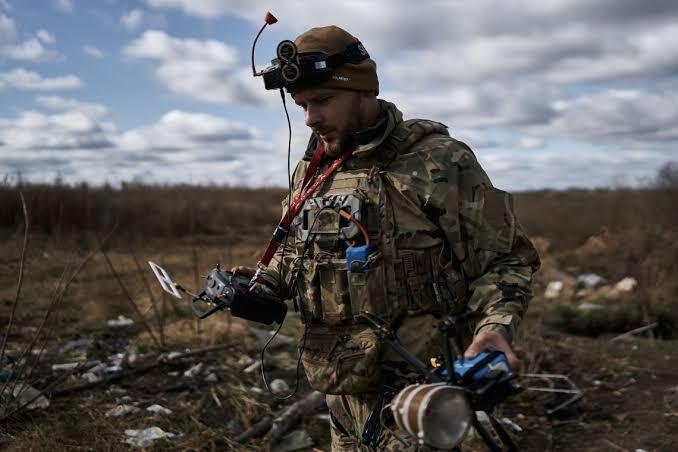
Ukraine’s structural advantage in adaptation has been most visible in drone warfare. Ukrainian procurement is comparatively decentralised: units can adopt systems at brigade level, test them in the field, and escalate successful ones through the chain. The P1-Sun interceptor, for example, was adopted piecemeal by individual units before its effectiveness earned it mass production.
Ukraine has also introduced a points-based system for confirmed kills of enemy personnel, equipment and drones, producing analysable battlefield data while creating direct incentives for units to find more efficient methods of engagement.
Russian procurement runs in the opposite direction: top-down, slow, and vulnerable to the corruption that has characterised Russian defence contracting throughout the war. The Yolka interceptor system, Russia’s principal drone countermeasure, is reported by troops on the ground to function reliably only in ideal daylight conditions, without rain or strong wind.
The cumulative difference is measurable: Ukraine intercepts over 90% of Russian drones nightly, according to Ukrainian air defence reporting, while its own long-range drones reach refineries in Tatarstan and St. Petersburg with limited interception.
The Western Factor
Western support has been the most publicly visible element of Ukraine’s resistance, and also the most frequently misunderstood. Hardware has received the most attention: Javelins, HIMARS, Patriot, and others. Most useful has been Western equipment filling specific capability gaps rather than transforming the battlefield wholesale.
HIMARS provided precision long-range indirect fire that Ukrainian howitzers and Soviet-era rocket systems could not replicate, and exceeded any equivalent Russian system in accuracy. Patriot integrated with existing S-300 infrastructure to extend Ukraine’s capacity to intercept theatre ballistic missiles, including the Kinzhal, and was used to down an irreplaceable Russian A-50 AWACS aircraft by using an S-300 radar as a guidance ambush for aircraft operating at what Russian planners considered a safe altitude.
Each of these systems followed the same trajectory: initial impact, followed by Russian adaptation, followed by diminishing but still meaningful returns. HIMARS lost its initial shock value when Russia moved supply depots and command centres beyond its GMLRS range; it still imposed costs, since every additional kilometre of distance from the front slows resupply and strains logistics.
Western intelligence has been less visible and more consequential. The sinking of the Moskva, the targeting of Russian refineries from Tatarstan to St. Petersburg, strikes on Baltic Fleet vessels in drydock, and the operation of a substantial portion of Ukraine’s drone fleet through Starlink connectivity all depended on Western satellite and intelligence capabilities.
The significance became measurable in negative: when the United States briefly withdrew intelligence sharing following the breakdown in relations between Trump and Zelenskyy, the previously successful Ukrainian operation in Kursk deteriorated rapidly. When Starlink access was restricted for Russian-occupied forces earlier in 2026, Russian territorial gains slowed noticeably and have not recovered.
Conclusion
Ukraine’s resistance has no single explanation. The defensive advantage was real, but insufficient alone: defenders can be overwhelmed, as the early territorial losses of 2022 demonstrated. Leadership mattered, but capable command without prepared forces achieves little. Western support was significant, but hardware and intelligence do not explain why Ukrainian units adapted faster, innovated more effectively, and held ground that Russian commanders had already marked as taken.
What four years of this war have demonstrated, above all, is that institutional quality compounds over time in ways that raw materiel cannot substitute for. The willingness to remove the incompetent, promote the effective, and trust units to solve problems from the ground up produced a force that consistently outperformed expectations. Russia came to this war with more of almost everything. Ukraine came with better answers to the questions the war actually asked.