Unenforced, not Unsolvable
Thirty years of climate treaties have produced agreement without compliance, because international law has no way to force a country to follow through.

IN 1992, when the United Nations Framework Convention on Climate Change was signed, atmospheric carbon dioxide concentrations stood at roughly 355 parts per million. Today they exceed 420. Global carbon dioxide emissions are around 60 per cent higher than they were in 1990. Over thirty years of negotiation, the architecture of cooperation has expanded dramatically – yet the physical trajectory of the climate system has continued to deteriorate. The puzzle is therefore not whether cooperation is desirable, but why it fails to bind behaviour. Climate change is frequently described as the greatest collective action problem in history. But is it truly unsolvable?
This essay argues that climate change is not inherently unsolvable as a collective action problem. Rather, it remains unsolved because international institutions lack credible enforcement mechanisms capable of transforming voluntary coordination into binding compliance. The empirical record – particularly the evolution from the Kyoto Protocol to the Paris Agreement – demonstrates that states can coordinate, but cannot yet compel one another. The obstacle is not collective irrationality, but institutional incompleteness under international sovereignty.
Collective (In)Action
Our starting point is Mancur Olson’s theory of collective action. When a benefit is non-excludable and non-rival – that is, when nobody can be shut out of enjoying it, and one person’s enjoyment does not diminish anyone else’s – rational actors have every incentive to free-ride, taking the benefit while leaving others to pay for it. A stable climate is precisely such a good. The costs of emissions reductions are immediate and domestic: higher energy prices, industrial restructuring, political backlash. The benefits are diffuse and global. Each state would prefer that others decarbonise while it continues emitting.
In a one-shot prisoner’s dilemma – the standard game in which two players each do better by betraying the other, even though both would be better off if neither did – defection is rational. If all cooperate, everyone benefits; but each actor has an incentive to defect regardless of what others do. This produces a collectively suboptimal equilibrium.
Yet Olson’s logic does not imply inevitability. Domestic collective action problems are routinely overcome. Governments tax citizens to provide public goods; firms are regulated to internalise the costs of their pollution rather than pushing them onto everyone else. This, despite being imperfect, functions far more effectively than any existing global climate framework. Thus the difference lies not in the nature of the problem, but in the presence of coercive authority. Collective action problems are solvable when institutions alter incentives through selective rewards or punishments. The question, therefore, is whether the international system possesses comparable mechanisms.
Repetition, Reputation and the Promise of Cooperation
International climate negotiations are not one-off interactions. States meet annually through the Conference of the Parties process. As Robert Axelrod showed in his work on the evolution of cooperation, repeated interactions can sustain cooperation through reciprocity and reputational incentives: when you expect to meet the same player again next year, betraying them today becomes expensive.
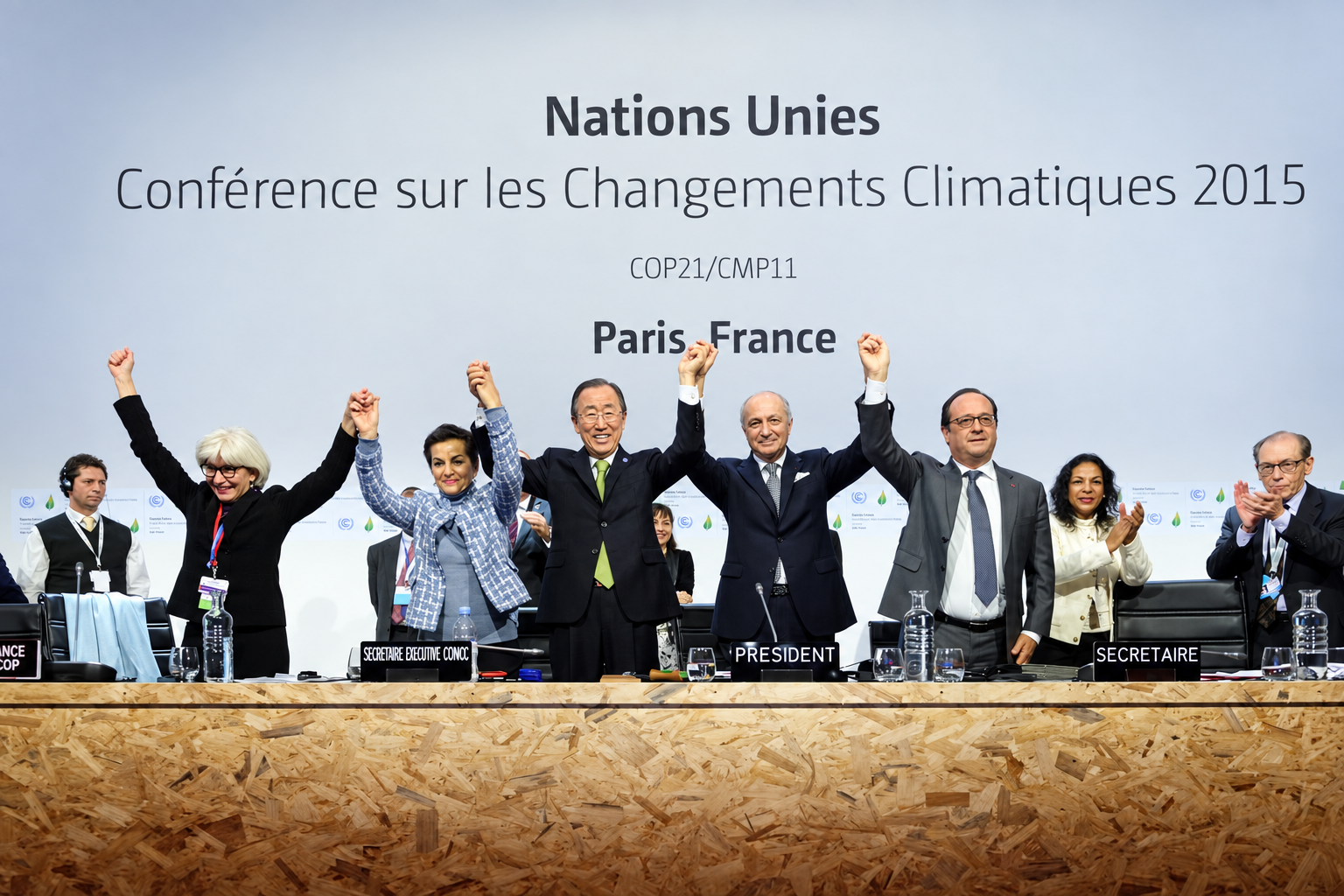
Indeed, significant coordination has occurred. The 2015 Paris Agreement achieved near-universal participation. Nationally Determined Contributions – the emissions pledges each country sets for itself – are publicly reported and reviewed. Long-term “net-zero” commitments have become widespread political norms. Transparency frameworks have improved monitoring.
If climate change were purely a coordination problem, these developments should have stabilised emissions. Yet the Intergovernmental Panel on Climate Change estimates that current policies remain insufficient to limit warming to 1.5°C, and global emissions remain close to record highs. The empirical evidence therefore complicates the simple prisoner’s dilemma narrative. States are not refusing to engage; they are pledging, reporting and negotiating. What is missing is not communication, but compliance. Climate change is not failing because actors cannot coordinate; it is failing because they cannot enforce.
Participation Versus Enforcement: Kyoto and Paris
The evolution of climate agreements provides a natural experiment in institutional design. The Kyoto Protocol of 1997 introduced legally binding emissions targets for developed countries, requiring the industrialised states listed in its Annex I to cut emissions by an average of roughly 5 per cent below 1990 levels during the 2008–2012 commitment period. In principle, this addressed enforcement. In practice, its reach was limited. The United States, then responsible for around 25 per cent of global CO₂ emissions, did not ratify it. Canada withdrew in 2011. Although many participating European states met or exceeded their targets, global emissions rose by approximately 40 per cent between 1990 and 2010. Compliance penalties were modest, largely involving adjustments in future target periods rather than immediate sanctions. Exit costs were low.
Institutional theory predicts precisely this outcome: where enforcement is weak and exit is cheap, commitments lack durability. Kyoto pursued binding obligations but sacrificed participation. The Paris Agreement of 2015 reversed the trade-off. It achieved near-universal membership by abandoning binding targets altogether in favour of self-determined, non-binding pledges reviewed through a “name and shame” transparency mechanism. Broad participation was purchased at the cost of enforceability. Kyoto bound a few; Paris bound none.
The Missing Sanction
What both treaties share is the absence of a credible penalty for non-compliance. Domestic tax authorities can fine, seize assets or imprison. No international body can do the equivalent to a sovereign state. The United States withdrew from the Paris Agreement once, under the first Trump administration, rejoined under Biden, and withdrew again in 2025 – twice in a decade, without incurring an economic penalty of any kind. Exit, in other words, remains cheap, exactly as institutional theory predicts it will where enforcement is absent.
Some genuine enforcement mechanisms do exist, and they are worth taking seriously precisely because they are the exception rather than the rule. The European Union’s carbon border adjustment mechanism taxes imports of carbon-intensive goods – steel, cement, aluminium – based on the emissions embedded in their production, which gives trading partners a direct financial incentive to decarbonise regardless of their own domestic politics. Climate clubs, in which a coalition of committed states agrees a common carbon price and applies tariffs to non-members, have been proposed by economists including William Nordhaus as a way of using trade policy to solve what treaty law cannot. These tools work because they attach a genuine cost to non-compliance, routed through something states already fear: losing access to markets.
Conclusion
Climate change is not an unsolvable collective action problem. It is an unenforced one. Thirty years of diplomacy have proven that near-universal participation is achievable, and that meaningful action is possible when institutions can compel it, as domestic climate and tax policy demonstrate every day. What has not yet been built is an international equivalent: a mechanism that makes defection costly enough to deter. Until enforcement catches up with ambition, the gap between the promises states make and the emissions they produce will persist – not because the problem is unsolvable, but because the tools to solve it have not yet been given teeth.