“Axe the Tax”
Explains why Canadian voters rejected a carbon tax that returned most households more money than it cost them.

WHY is it so difficult to get people to support a policy that charges them for pollution, even when the policy gives the money back to them? In Canada, the federal carbon pricing system became law on 21 June 2018, introducing charges designed to make environmentally harmful behaviour more expensive and so create an incentive for people to reduce their carbon footprint. The plan had been set out in October 2016, when Ottawa told every province and territory that it had to adopt either a carbon tax or a cap-and-trade system – a scheme in which a government caps total emissions and lets firms buy and sell permits to pollute within that limit. On 1 April 2019 the federal “backstop”, the system that applied automatically wherever a province had not built one of its own, took effect. It carried two halves: a consumer fuel charge on petrol, natural gas and other fossil fuels, and a rebate paid back to households.
The design survived its constitutional test. In March 2021, as Fatima Syed reported for The Narwhal, the Supreme Court of Canada ruled the policy constitutional, making the tax-and-rebate model the mandatory, country-wide baseline for cutting emissions. Fossil-fuel use would become progressively more expensive, encouraging people to invest in cleaner ways to heat their homes and travel. All of this sat inside the federal government’s pledge to cut emissions 40 per cent below 2005 levels by 2030.
It is worth being precise about how much of that target the consumer charge was actually carrying, because the two halves of Canada’s carbon price do very different amounts of work. Modelling published by the Canadian Climate Institute’s 440 Megatonnes project in March 2024 found that the consumer fuel charge – the part households pay at the pump – accounted for only about 8 to 9 per cent of the emissions Canada expected to avoid by 2030. The industrial carbon price, which applies to large emitters such as refineries and steel mills and which almost no voter ever sees, accounted for 23 to 39 per cent.
Carbon pricing as a whole was expected to deliver somewhere between a quarter and a half of the reductions Canada had committed to under the Paris Agreement. In other words, the piece of the policy that generated nearly all of the political anger was the piece doing the least environmental work.
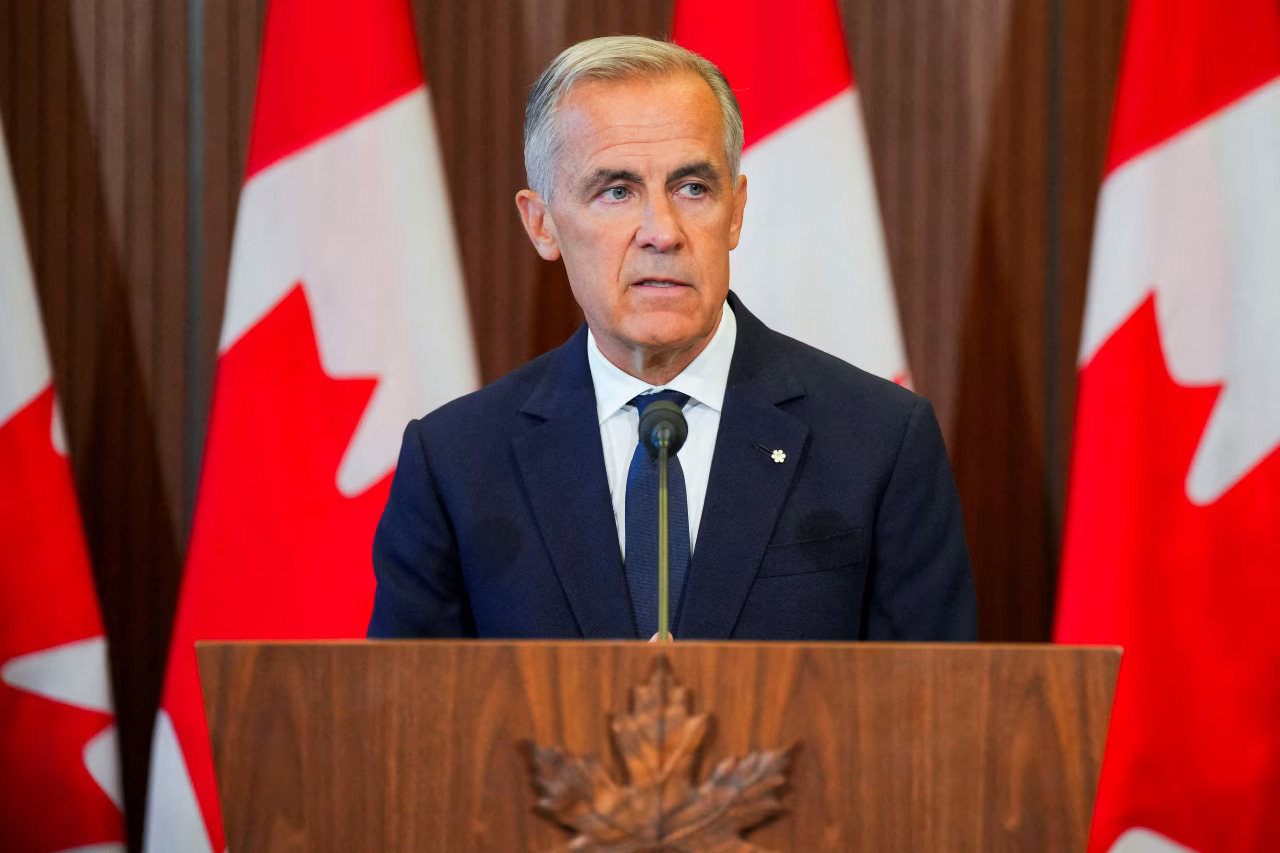
The anger won. In March 2025, as the CBC’s Darren Major reported, the incoming prime minister, Mark Carney, signed a directive on his first day in office ending the consumer carbon tax, effective 1 April 2025. The final Canada Carbon Rebate landed that same month. The industrial carbon price survives, and a federal review of the benchmark that governs it is due during 2026 – so Canada still has a carbon price. It simply no longer has the one that ordinary people could feel.
The reason for the reversal was that the public had come to see Canadian carbon pricing through a political narrative in which the policy was hurting Canadians. That narrative persisted even though the majority of households received more money through the Canada Carbon Rebate than they paid through the charge. Much of the backlash came from Conservative messaging – above all the slogan “axe the tax” – which claimed that carbon pricing was driving the cost-of-living crisis.
The numbers do not support that. In September 2023 the Bank of Canada put the carbon charge’s direct contribution to inflation at 0.15 percentage points a year, at a time when the headline rate was around 3 per cent and had peaked above 8 per cent the year before. Research goes further still: a study of Canadian provinces by Jiansong Xu found that carbon pricing had a deflationary effect on food prices – that is, it pushed them down rather than up – though Xu cautions that this probably reflects households buying less rather than a genuine welfare gain. A significant number of Canadians nonetheless ended up supporting the elimination of a policy that left them better off on average.
So if the policy included a rebate designed so that most households would receive more back than they paid in direct carbon charges, why was it viewed so negatively? Rebates were part of the design from the beginning, yet Matto Mildenberger and colleagues, writing in Nature Climate Change, found only limited evidence that they increased public support for carbon pricing anywhere they have been tried.
But why would people not support a policy that pays them? In a purely rational society – the society assumed by most neoclassical economic theory, and by most of the policy built on it – this scheme would be viewed favourably. The world, however, is not purely rational. That is where behavioural economics comes in.
Where Behavioural Economics Comes In
Behavioural economics studies what people actually do, rather than what a model says they should. Two of its findings explain the carbon tax backlash particularly well. The first is loss aversion: people feel the pain of a loss roughly twice as strongly as the pleasure of an equivalent gain, so a visible charge at the pump registers far more powerfully than a quarterly deposit that arrives, until 2024, under the anonymous label “EFT Canada” on a bank statement.
The second is salience: the cost was felt every time a driver filled a tank, several times a month, in large digits on a screen at eye level, while the rebate arrived four times a year as a single, unremarkable line among many others.
Framing compounds both effects. A tax framed as a cost is processed differently from an identical amount framed as a rebate, even when the two exactly offset one another, and “axe the tax” is a framing built entirely around the cost half of that pairing. The result is a policy that could be, on the numbers, a net gain for most households, and that a majority of the public nonetheless experienced, and eventually voted to end, as a loss.
Conclusion
Canada’s carbon tax was not undone by economics. On the numbers, most households came out ahead, inflation was barely affected, and the environmental heavy lifting was being done by a different, invisible policy that survived the repeal entirely intact.
It was undone by psychology: a visible cost, felt often, beat an invisible benefit, felt rarely, in a contest that behavioural economics could have predicted well in advance. Any government designing the next generation of climate policy would do well to remember that being right about the arithmetic is not the same as winning the argument.