Shivers Down the Spine
A Yale doctor and sociologist who first saw Saturn's rings as an eighth-grader says scientists owe a debt to the taxpayers who fund their work.


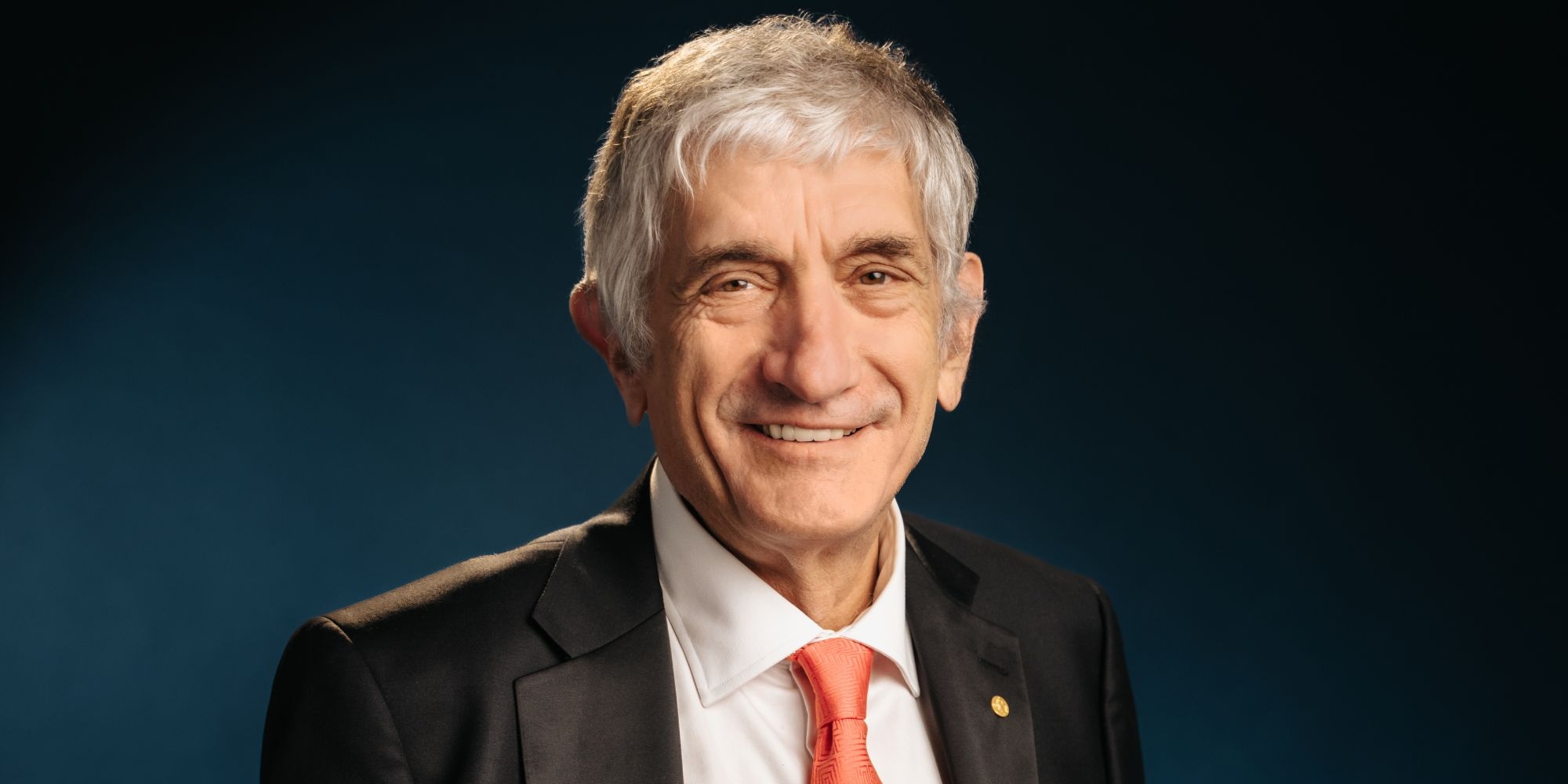
NICHOLAS Christakis holds Yale's highest academic rank as Sterling Professor of Social and Natural Science, and directs the university's Human Nature Lab and the Yale Institute for Network Science. Trained as both a physician and a sociologist, he studies social networks, how human societies evolved, and what happens to groups of people when artificial intelligence joins them. He also hosts For the Love of Science, a YouTube channel about the craft of discovery.
We asked him what discovery feels like, why scientists owe it to the rest of us to share what they find, and what he learned from students in wartime Kyiv.
The Confluence: In your video The Feeling of Discovery you describe the spine-tingling moment of finding something new. For a teenager who has only ever done experiments with a known right answer, how can they get a first taste of that feeling before university?
Dr. Christakis: I think many teenagers read about discoveries, the scientists who make them, and the thoughts scientists have about those discoveries, and imagine all this as very cerebral. But I think it's important to realise that making a discovery is often motivated by feelings, not just thoughts, and that, symmetrically, discoveries themselves can indeed evoke feelings. And teenagers are human beings who are quite familiar with both of those aspects of feelings. So I think that, even just by analogy, they can imagine the excitement that is associated with discovery, though, of course, the feeling of scientific discovery is indeed very special.
I also think that one can get an approximation of that feeling even if one is just recapitulating known discoveries, because you can have a similar feeling when you discover something for yourself for the very first time. I remember when I really understood what integration [a technique for adding up infinitely many tiny pieces] was about when I was taught calculus in high school, or when I began to have a glimpse of understanding about what electron shells were really all about. Or even when, in eighth grade, I saw the rings around Saturn through a telescope set up by my science teacher one night. I knew the rings were there, of course, but I still got shivers down my spine. It's very exciting.
The Confluence: That video also makes the case that scientists have an obligation to share what they find with the public. Why does that matter so much to you, and what is lost when scientists keep their work to themselves?
Dr. Christakis: I think there are two aspects to the answer to this question. First, scientists, when they do their work, enter a conversation that has been taking place for centuries; because they benefit from the prior contributions of others, they have a moral obligation to make downstream contributions to others: to pass it on. This requires communication not just with fellow scientists, but with the public at large, because science is a part of society.
There are famous cases of scientists who kept discoveries to themselves, such as Isaac Newton, who did not widely share his invention of calculus until he heard that Leibniz [the German mathematician Gottfried Wilhelm Leibniz] had also discovered it, or the British obstetrician Peter Chamberlen, who kept his invention of forceps used to deliver babies as a private secret, at around the same time Newton was keeping his own. We generally look askance at those things, don't we?
Second, it's important to understand how science is supported. Most of the science that has been done for hundreds of years has been supported by wealthy patrons or by tax dollars. That money doesn't flow to scientists so that they can have private lives that are stimulating and fulfilling in a self-centred way. It flows to support a broader social enterprise that comes with social obligations.
The Confluence: You travelled to Ukraine to talk to scientists working there. What did seeing people do science under those conditions teach you about why people do science at all?
Dr. Christakis: In September 2025, while Russia's war against Ukraine was still going on, I was invited by the Kyiv School of Economics to give some lectures on social artificial intelligence. My laboratory has been doing work on how adding AI agents [programs that act on their own] to human groups, forming "hybrid systems" of humans and machines, affects the properties of those groups.
I spent two days visiting, and I was astonished at the commitment and inventiveness of the students there. Here they were struggling to learn, eager to learn, even when they were obliged to move their classes deep underground into bomb shelters during air raids.
It made me ashamed that some students and teachers in better circumstances in the USA take for granted what we have. But it also illustrated a deeper point: that the desire for learning is very fundamental and even irrepressible, to the point where it is manifested even in times of war. Curiosity and learning illustrate our humanity, even during social upheaval.
The Confluence: Many of our readers lean towards the social sciences rather than the lab. Which parts of the craft of science matter most for someone who wants to study people and societies rather than cells or stars?
Dr. Christakis: In virtually all of the important and fundamental ways, I see the social sciences as part of science more generally. The social sciences share all of the key features of the natural sciences, including careful observation, empiricism [relying on observed evidence], and reproducibility. Our most fundamental obligation as scientists is to see the world as it is, not as we wish it to be. That's the essence of science.
So the craft I try to show on For the Love of Science applies just as well to students who want to study the behaviour of people and societies as to students who want to study the behaviour of cells, animals, atoms, or stars.
Dr. Christakis's YouTube channel, For the Love of Science, is at youtube.com/@NAChristakis.