Strap a Rocket to the Horse
A Nobel Prize-winning physicist looks back on the circuit that stood in for an atom and tells students to keep doing their own problem sets in the age of AI.

IN 2025 John Martinis shared the Nobel Prize in Physics with John Clarke and Michel Devoret "for the discovery of macroscopic quantum mechanical tunnelling and energy quantisation in an electric circuit". The experiments behind it were done in 1984 and 1985 at the University of California, Berkeley, when Martinis was a PhD student in Clarke's laboratory. They showed that the strange rules of the atomic world can govern an electrical circuit big enough to hold in your hand, and that discovery grew into the superconducting circuits, chilled until they carry electricity with no resistance at all, inside many of today's quantum computers.
Martinis went on to lead Google's quantum hardware team, which in 2019 claimed "quantum supremacy" for its Sycamore processor: a calculation, it said, that no ordinary computer could finish in any reasonable time. Sycamore ran on 53 qubits, the quantum counterpart of a computer's bits, which can be 0 and 1 at the same time. He is now professor emeritus at the University of California, Santa Barbara, and co-founder and chief technology officer of Qolab, a start-up trying to build quantum computers the way the chip industry builds microprocessors.
We spoke to him about the Nobel work, the hype around quantum computing, and why students should resist letting AI do their homework.
The Confluence: Could you start by telling us about your background and how you came to work in this field?
Dr. Martinis: I'm a physicist. I've been doing physics for my whole career; it's what I studied both as an undergraduate and in graduate school. In graduate school I did my thesis experiment on macroscopic quantum tunnelling [a large current slipping through an energy barrier it classically could not cross] and energy-level quantisation. It was an interesting experiment at the time, and because this has become a big field over the years, it was awarded the Nobel Prize last year.
The Confluence: That work came from experiments you did as a PhD student with John Clarke and Michel Devoret in the mid-1980s. Did it feel important at the time, or did that only become clear decades later?
Dr. Martinis: At the time we thought it was kind of important; that's the way we approached it. There were a few experiments before us, but they weren't done in a very conclusive way, I would say because I don't think people thought it was an important experiment. We thought it was a very fundamental physics question, and we wanted to do it very, very well.
In doing this experiment we were able to prove that quantum mechanics was definitely being seen in these systems, by measuring all the parameters and making sure all the physics was correct. I think its importance came about because we did it so that we really understood the physics well, and we combined microwave engineering concepts with quantum mechanics (it's an electrical circuit, after all) in a way that people could then build upon in subsequent experiments.
That's really why the Nobel Prize was awarded: not just for this experiment, but because it developed into a huge field with thousands of people working on it now. Of course, many other people contributed to that understanding. But what we did at the time was put the field on a solid foundation: how to think about it, how to build these systems, how to do the experiments very cleanly.
The Confluence: Many of our readers will be new to quantum physics. How would you explain your result, that a circuit you can hold in your hand can behave like a single quantum particle?
Dr. Martinis: I would start by saying that quantum mechanics was invented to understand how small systems work: how atoms work, how molecules work, how light works. So for years and years quantum mechanics was thought of as the physics of the small, and that's true. Take the electron in a hydrogen atom, orbiting the proton nucleus. Classically [under pre-quantum physics], the two would simply attract each other and atoms wouldn't have any size. But because of quantum mechanics atoms do have size, because the electron is, in a sense, in more than one position at the same time.
What we did was show that quantum mechanics applies more widely than just to the physics of the small. Basically any system can behave quantum mechanically, provided you put it into the right conditions. Quantum mechanics is fragile, so in our case we had to go to very low temperatures and do a lot of work filtering out noise and light.
What you can picture is a current in a wire. Classically, the current flows in one direction, or perhaps over time it flows in the other direction. But quantum mechanically it can flow in both directions at the same time. You then have to describe it in a quantum mechanical way, with a wave function [the maths describing every state the system could be in]. That's what we showed with the various phenomena: the description of the currents and voltages is no longer classical, and you really have to think about it as quantum mechanical.
The Confluence: In 2019 your team at Google said its quantum computer had done a calculation in minutes that would take the best supercomputers thousands of years. IBM disputed this. Looking back, what did that result prove, and what did it not prove?
Dr. Martinis: I'd say the dispute by IBM was kind of fake news. They're obviously in competition with Google. IBM claimed that the Summit computer [then the world's most powerful supercomputer] could do the calculation, but it was a paper study: they never ran it. And the way they proposed to run it, storing things on hard disks, is not the way the people at Summit would ever run it. So it was just a marketing ploy, in my view, by IBM to claim that you could do something when they hadn't actually done it.
We worked really hard to do the experiment and to run it on Summit and other computers to do it properly. For me it was kind of amusing; I made fun of the whole paper at some of the conferences I went to, and I think people understood it was a competitive thing. As far as I know, IBM has never done this experiment, and it makes me wonder whether their computers were good enough. Maybe they are now. But all the other modalities [rival ways of building qubits] have tried it and shown that it works. It's actually a test of how good your computer is. But IBM is really good at marketing.
The Confluence: Quantum computing attracts big companies and a lot of investment, but also a lot of hype. How can a student, an investor or a government tell real progress from overblown speculation?
Dr. Martinis: What I try to do in all my talks is discuss this in a scientific way: talk about what the real metrics are, and then treat it as a systems engineering problem. But I find that talking about four or five aspects at once is beyond what most people think about, which is kind of sad when it comes to investment and government. That's just not the way people think about these things.
People think about it as a horse race: who's ahead right now, and what are people talking about. What I'm trying to do is strap a rocket onto my horse, so that in the long term we're going to be really ahead. Some people understand that. But I've been unsuccessful at this often enough to accept that it's just the way it is. People want to think about it as a horse race, and I can understand that.
The Confluence: There are also big state actors, the US, China and European governments, pouring money into this as a national-security race. Is that good for the science, or does it get in the way of open discovery?
Dr. Martinis: That's always a good point. If it's a technology race, I can understand that the US government and other governments want to be in it. The same thing happens in Europe: they have funding and they want to develop a quantum computer in Europe to take advantage of any economic opportunities. That's part and parcel of funding quantum computers.
In our field, for example, people tend not to talk about how to manufacture the qubits really well. Some people do, but a lot of the big companies don't. If you look at the semiconductor industry, this is the kind of thing companies typically keep secret to protect their intellectual property, and that's what's happening here. I think we would make more progress if people shared it, but I can understand why they don't, and we have to do it for our company too. It's just part of what you have to do.
So I think it's a two-edged sword. The important thing is that people are well funded and all these ideas are progressing. Right now, for example, neutral atoms [atoms held in place by lasers and used as qubits] are doing quite well and there's funding for that. Superconductivity was the favourite for a long time, and now people are really looking at neutral atoms. I think it's healthy that a new idea can come along and gather a lot of attention. In the end I think superconductivity has certain advantages once we solve certain problems, but that's all fair.
The Confluence: You left Google and co-founded a start-up, Qolab, to keep building quantum computers. Why, and what can a small company do that a tech giant cannot?
Dr. Martinis: Working with Google was great because we had a lot of resources; in fact, when I left they were just starting to ramp up. But the real problem was that after the quantum supremacy experiment they reorganised the group, and basically no one would listen to my advice any more. I would say I basically had negative influence on the group. And if you're a senior person and no one's listening to you, then what's the point of working for a company? They were paying me well, but I was having negative influence, and that's because a lot of politics entered into it, and various things we don't need to go into.
So for me personally it was much better to leave and start a small company. With our start-up, I thought very carefully about where the field was going, not next year but five or ten years ahead, and because of that we came up with new ideas on how to build a quantum computer in a much more scalable way. I'm really happy with it, because I think we're working on technology that can leapfrog what all the companies are doing with superconducting qubits. As a small company there's only so much you can do, but we identified something we thought was very transformational for the field, we've been able to get the funding, and we're continuing to work on it.
As a physicist, that's what you're always looking for. You may be proposing things that everyone thinks won't work, and that's the case with what we're doing now. But that's been my whole career: proposing things that are different from everyone else, and I would say I have a pretty good track record of understanding what to do. If Google didn't understand that, then I should leave and try to do it on my own.
That's very typical of big companies, and it's the reason start-ups exist. Companies like to do things incrementally. When people want to do something transformational, they found start-ups, because that's the way it can happen. And it's fun: I like having my own company and helping to define its direction.
The Confluence: Quantum research has moved from universities to giants like Google and IBM, and now increasingly to start-ups. Which is best at producing breakthroughs, and which is best at turning them into a working, useful quantum computer?
Dr. Martinis: Big companies have distinct advantages because of their infrastructure and the money that can be put in. Start-ups have an advantage because they can try new ideas that are foundationally different and change things. Both are very valuable, and whether one succeeds or not depends on the technology and the ideas.
I like to use SpaceX as an example. SpaceX was a start-up and now it's a big company, but it has a culture where people are really working to manufacture rockets successfully, and that's good because of its culture. I think big companies succeed or fail because of their culture. Like I said, Google was fine for the time I was there; then they changed their management and their culture, and I just didn't fit in any more, so it was better that I leave.
So it's not that one is better than the other: there are a lot of variables, and it depends on the particular technology. I'm just happy that I'm in a company where people are listening to my ideas and we're trying out new things that are hard, but which, if they come to fruition, will be very valuable.
Because we're doing something different from everyone else, it's a little harder to raise money. We have investors who understand what we're trying to do, transforming the field, and why, but only a fraction of investors want to do that. Most investors respond to a pitch where you have some new physics (which of course they don't understand, because it's quantum) and you claim that in a couple of years you're going to build something big and transformational. Our story is that superconducting qubits work really well, but they have a scaling problem that you can really see, and we have a path to solve it. It's a hard path, but we know how to do it. It's a different pitch.
The Confluence: You have argued that the hard part is now less the physics than the engineering: the wiring, the manufacturing, getting thousands of qubits to work together. Why is scaling up so difficult, and what does Qolab do differently?
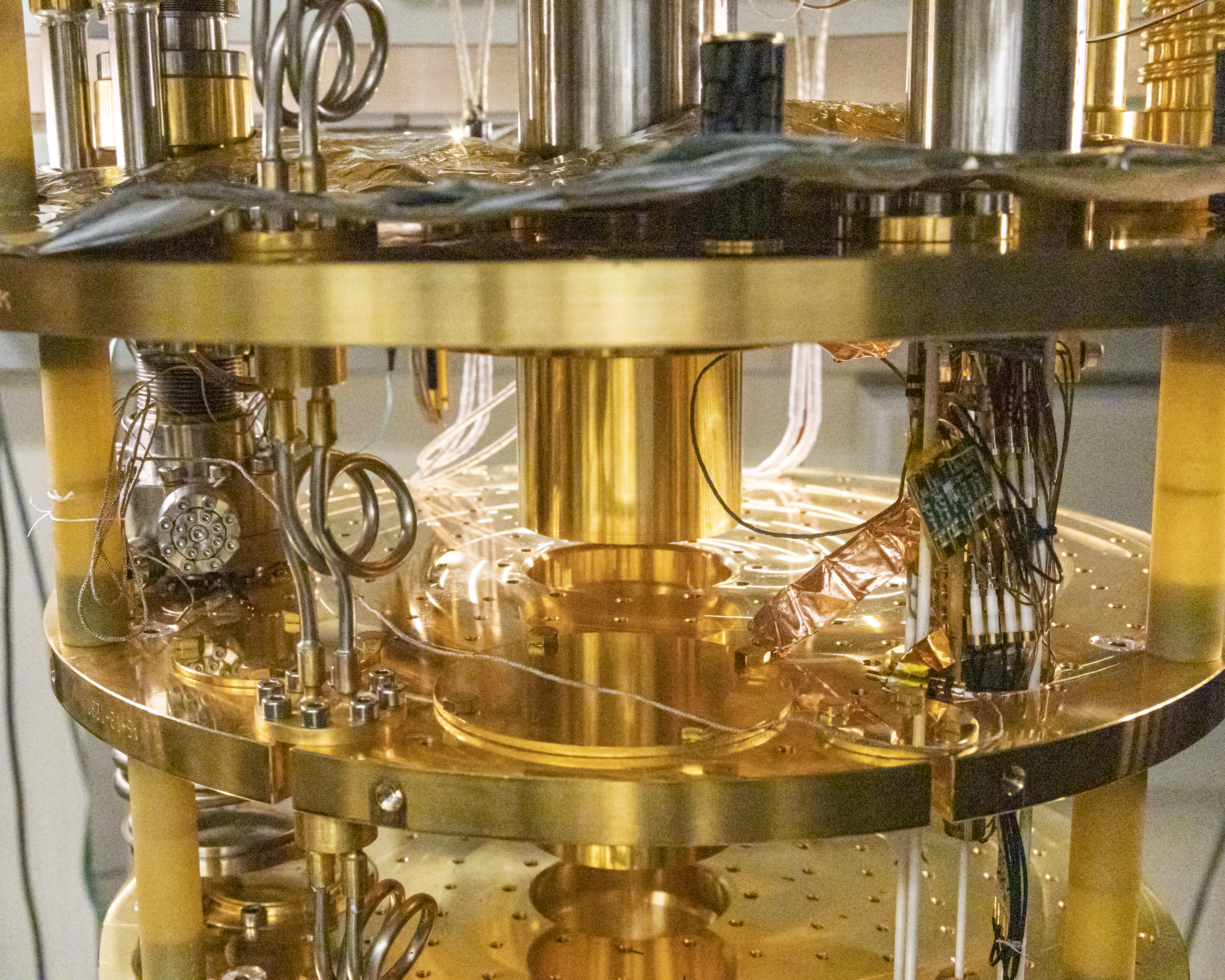
Dr. Martinis: That's a very interesting question, and for us it was very natural. If you look at superconducting qubits right now, you have a central chip with all these wires, coaxial cables, connectors and microwave components outside it. To us, that looks like what computers looked like in the 1950s or 60s, with individual transistors [tiny electronic switches] and lots of wires, well engineered of course.
But the real transformation came with the integrated circuit, and that's what we want to do: build this out of integrated circuits, integrating all the components onto a wafer [a thin silicon disc on which many chips are made]. That's hard. You have to change every component to do it. So that's what we decided we had to do, and then we figured out in detail how to do it; there are a lot of inventions involved.
It's a different mindset. Other people are talking about taking what they're doing now and just scaling it up, with huge dilution refrigerators [machines that cool chips to a few thousandths of a degree above absolute zero]. If you look at the semiconductor industry, that's what people did in the 60s: they built big computers. But in the 70s they started to shrink them down, and once you figured out how to make the microprocessor, you could evolve that to make small computers. It's a technology shift, but also a mindset shift, and not everyone can make it.
Big companies propose a certain direction and want to keep going in it, because that's what they proposed to their management. As a start-up we can take the risk of doing something different. I've talked to people at other companies, big companies, and at Google, and everyone thinks this is kind of crazy, because we have to do so many things differently. That's okay. That's how you change the world.
The Confluence: When useful quantum computers arrive, what will change? Some predict the biggest impact will be on medicine, materials or finance; others that encryption will stop being secure.
Dr. Martinis: In fact, the easiest impactful algorithm to run is breaking encryption: RSA and elliptic-curve codes [the codes that protect most online banking and messaging]. However, people know there are quantum-resistant algorithms, and people are working right now to shift over. My view is that they'll be able to do that faster than anyone can build a quantum computer, but not necessarily by much, so people really have to get working on it.
I'm very pleased that my son, who works at Google, is on the team rolling out quantum-safe encryption. It turns out the encryption part is simple; it's all the infrastructure around it, making sure it runs fast, with low latency [little delay] and so on, that's the key thing. So it's really great that Google and lots of other companies are working on that.
But I'm really excited about quantum materials and quantum chemistry, which was proposed by Richard Feynman [who in the early 1980s proposed simulating nature with quantum machines] a long time ago. It's a use of big supercomputers right now: my rough guess is that something like 20 or 30 per cent of big supercomputer time goes on it. If people learn how to map these quantum simulations onto a quantum computer, I think that could make a really big impact. If you can design better materials and better drugs, that can be very valuable and really benefit the world.
There are other things, to do with optimisation and machine learning, which are also very interesting, but it's not clear we have the algorithms yet. My suspicion is that once you build a big quantum computer and play around with it, you'll find them. Right now there are just small demonstration experiments, which are nice, but it's not clear they will be the killer app. It's a definite possibility. But if quantum chemistry and quantum materials are all that comes out of quantum computing, in my mind that would be such a benefit to humanity that it's a good goal in itself.
The Confluence: If you could put just one question to a fully working quantum computer, what would it be?
Dr. Martinis: I would definitely do quantum chemistry experiments, and then combine the quantum computer with machine learning. People have suggested some very clever ways to use them together. Machine learning for quantum chemistry is actually pretty good: it gives you possible target reactions or molecules to look at. If you had a quantum computer, you could generate more quantum data to train the machine learning better, or take the proposed molecules and do a bit more quantum calculation on them to narrow the list down.
That matters because in the end you have to synthesise these things in the lab, so it's a filtering problem. The quantum computer can help at the top end, training your models better across a wide variety of possibilities, and at the bottom end, where you're filtering down to the best candidates. If you can do that, you can save a lot of money and speed up discovery. I'd guess it will be done in conjunction with machine-learning algorithms.
The Confluence: Some of our readers may want to work in quantum one day. Should they study physics, engineering, maths or computer science?
Dr. Martinis: The quantum computing field needs people with all of these backgrounds. My own background is physics, but I do a lot of electrical engineering and electronics design, I know about materials and fabrication, and I appreciate good computer science development, especially after working at Google. You can be useful in a wide variety of ways.
If you want to get into the field, you probably want to take at least an undergraduate quantum mechanics course, just to understand what quantum mechanics does. But it's equally useful to have expertise in materials science, engineering, chip design or other things the project needs. That's what makes the field so interesting: it really involves a lot of skills.
The Confluence: Looking back on your career, what advice would you give students going into this field, or into STEM generally?
Dr. Martinis: There's one piece of advice I now give, and it has to do with AI. AI is becoming very powerful, and it's easy to think that if you get a problem set [a sheet of homework problems], you can pose it to AI and get the answer. You understand roughly what's going on, and you hand it in. But what's not happening is that you aren't struggling with the problem and really learning the concepts deeply.
If you want to be a physicist in particular, your job is to discover new science that AI doesn't know about. Maybe someday it will invent things, but generally AI puts together things it already knows about, especially in physical science; maybe mathematics is a little different. If you want to be competitive in the job market and do physics where you discover new things, you have to train yourself to solve problems that have never been solved before.
So for every problem set, starting in high school and through undergraduate and graduate school, you need to work on the problem yourself, to train yourself how to solve problems, not look it up. All the problems you're practising on can be looked up, and if you take the easy way out you'll be fine on that problem set. But you won't be training yourself to solve new problems, which is the whole point of being a scientist.
The students I talk to all know that. What I'm trying to do is encourage them to take the slightly harder route and solve these problems themselves, because that's how you really learn physics and learn to do something new. If you can't solve it yourself, go and talk to your friends. Even looking it up is better, because at least you have some idea, but it's not the optimal way. You should be figuring most of it out by yourself or with your friends.
That's the big thing. What I worry about with AI is that if students don't train themselves, then scientists 20, 30 or 40 years from now won't know how to solve problems, and that's a big problem for science.