Read Science, Not Just About It
A Nobel Prize-winning physicist calls research slow, collective work and describes how his spin-glass mathematics was applied to memory in the brain.
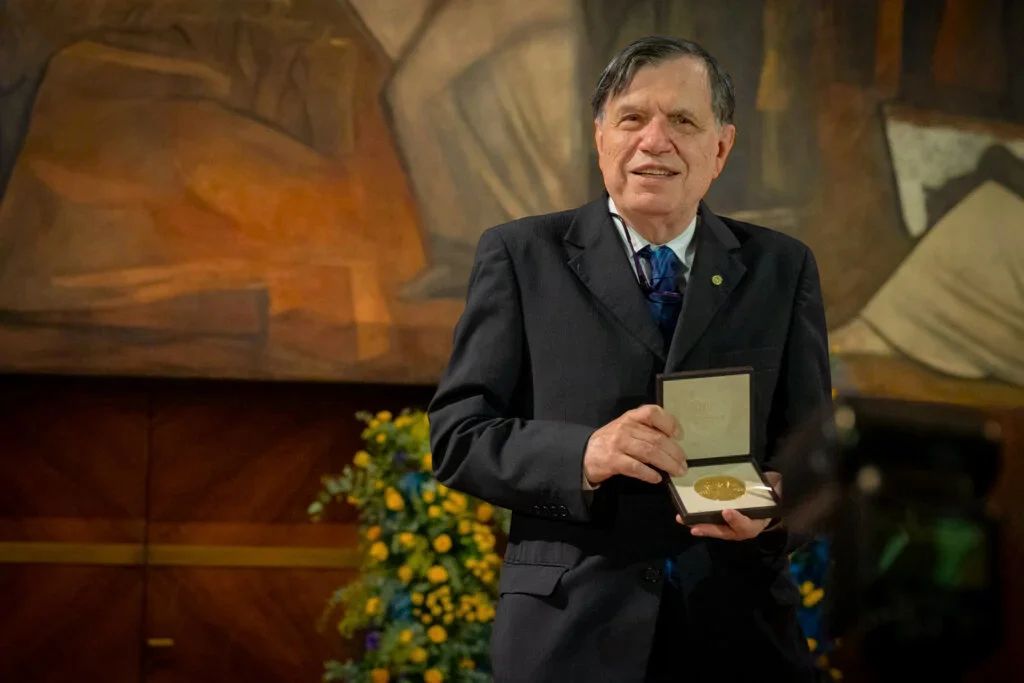
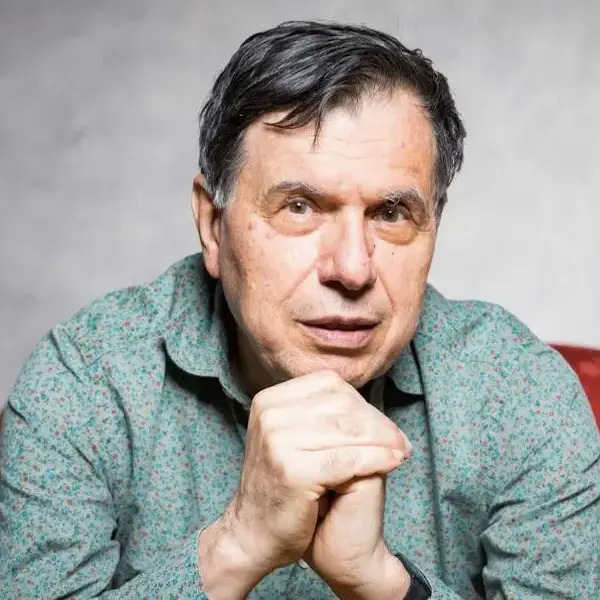
GIORGIO Parisi is an Italian theoretical physicist at Sapienza University of Rome. He was awarded the 2021 Nobel Prize in Physics, shared with Syukuro Manabe and Klaus Hasselmann, for discoveries on the interplay of disorder and fluctuations in physical systems, above all his solution to the spin glass problem [a puzzle about metal alloys whose atoms behave like tiny magnets pulling against each other in random, conflicting directions]. The mathematics he developed for it has since been applied well beyond physics, from neural networks to the movement of flocks of birds.
The Confluence: What first drew you toward physics research?
Prof. Parisi: Nobody drew me to physics: there was no teacher and no particular moment. At my liceo [Italian academic secondary school] in Rome the teachers were not bad, but none of them fascinated me, and I never had a real mentor. What I had, from the age of eleven or twelve, was a private passion for mathematics.
I read histories of mathematics in a library next to the school, filled notebooks with calculations, and at thirteen I tried to solve the fifth-degree equation with school algebra, because I had read that it could not be solved [mathematicians proved in the 1820s that there is no general formula for equations of the fifth degree]. Of course I did not succeed, but I remember the pleasure of trying.
The histories of mathematics stopped at the nineteenth century, while the physics of the twentieth century, Fermi, quantum mechanics, the first accelerators, had been told many times in popular books: I could imagine what a physicist did, not what a mathematician did. After my final exams I was undecided between mathematics and physics, and I chose physics. Believe it or not, I still cannot explain exactly why.
The real turning point came at the end of my first year at university, when a friend mentioned the physicist Lev Landau’s textbooks, and I realised I could buy real books and study them on my own, some of them in French, a language I did not know. The formulas help. From that moment I stopped looking at science through the keyhole.
The Confluence: What would you say to a young person curious about science?
Prof. Parisi: Science is a huge puzzle. Each piece placed correctly makes it possible to place others, and the more we explore, the more new questions appear that we could not even formulate before. If you enjoy this game, science is a good path. My teacher Nicola Cabibbo used to ask, when we were deciding what to work on: why should we study this problem if we are not having fun? I still think this is the right criterion.
What I wish someone had told me at sixteen is very simple: do not only read about science, read science. I spent years reading the history of mathematics in a library without ever opening a real mathematics book, which was on a shelf in the same library.
A real book is harder: at the first reading you understand a small part, at the second reading a little more. But it is the only way to pass from spectator to player.
Two more things. Research is mostly slow and collective work; the picture of the lonely genius is false, and most of what I have done I did with friends and colleagues. And do not be afraid of being wrong. On spin glasses I groped in the dark for months before finding the solution, and when I found it I did not fully understand what I had done: that took years, and other people.
The Confluence: Is there an idea from your work on spin glasses that turned out to explain something far outside physics?
Prof. Parisi: The most concrete example is memory. In 1982, John Hopfield proposed a model of associative memory [memory that retrieves a whole stored pattern from a partial cue, as a few notes can bring back a whole song]: many neurons, each either active or inactive, all connected to each other, with the strength of the connections fixed by the memories one wants to store.
Hopfield noticed at once that his model was mathematically a spin glass: a system of magnetic atoms interacting with random couplings, where we knew that many stable states exist.
A few years later, Daniel Amit, Hanoch Gutfreund and Haim Sompolinsky used the replica method [a mathematical technique that studies many identical copies, or replicas, of a system at once], the technique developed for spin glasses (my contribution had been to understand how to use it when the symmetry among replicas is broken [when the copies stop behaving identically]), to compute how many memories such a network can hold: about 14 for every 100 neurons, or 0.28 bits per synapse [a synapse is a connection between two neurons]. A precise, testable number about a biological question, obtained with tools built for a magnetic alloy.
What did this teach me? Bertrand Russell said that mathematics is the science in which one never knows what one is talking about, and that is exactly its strength. The equations do not know whether the variables are atoms, neurons, or guests at a dinner who must be divided into two tables according to their sympathies and antipathies.
Whenever many simple elements interact under conflicting constraints, the same landscape appears, with many nearly optimal states. Nature does not need to reuse anything on purpose: it is enough that the structure of the problem is the same.