The Virus and the Voter
Covid emergency powers damaged trust in democracy, but the backlash since, from Sri Lanka to Hungary, has so far done more for democracy than the emergency did against it.

IN 2019 the Economist Intelligence Unit (EIU) counted 22 “full democracies” in the world. Its Democracy Index scores 167 countries on 60 indicators across five categories: electoral process and pluralism, the functioning of government, political participation, political culture and civil liberties. By 2021 the count had fallen to 21. By 2025 it stood at 26, the highest it had been in years.
That rebound is the puzzle this article sets out to explain. The pandemic brought what the EIU called perhaps the biggest rollback of individual freedoms ever undertaken by governments in peacetime, justified as the price of handling a public health crisis that killed millions.
The question is whether suspending ordinary politics opened the door to a new authoritarianism, or whether it planted the seeds of something healthier. My answer is both, in that order: the damage came first and was real, but the backlash against it has so far done more for democracy than the emergency did against it.
The Damage
The harm showed up quickly in the numbers. Canada’s score fell from 9.24 to 8.87 in the 2021 index. France slipped below 8.00, the line that separates a full democracy from a flawed one, and did not climb back above it until 2025, when the EIU credited the recovery to personal freedoms returning to normal after pandemic restrictions. Emergency powers were written into law, and many institutions came out of the period weaker than they went in.
But a scar is not the same as a permanent disfigurement. The rest of this article follows the damage through two channels, emergency law and public trust, and then follows the recovery through two more: protest and the ballot box.
The Emergency That Became a Precedent
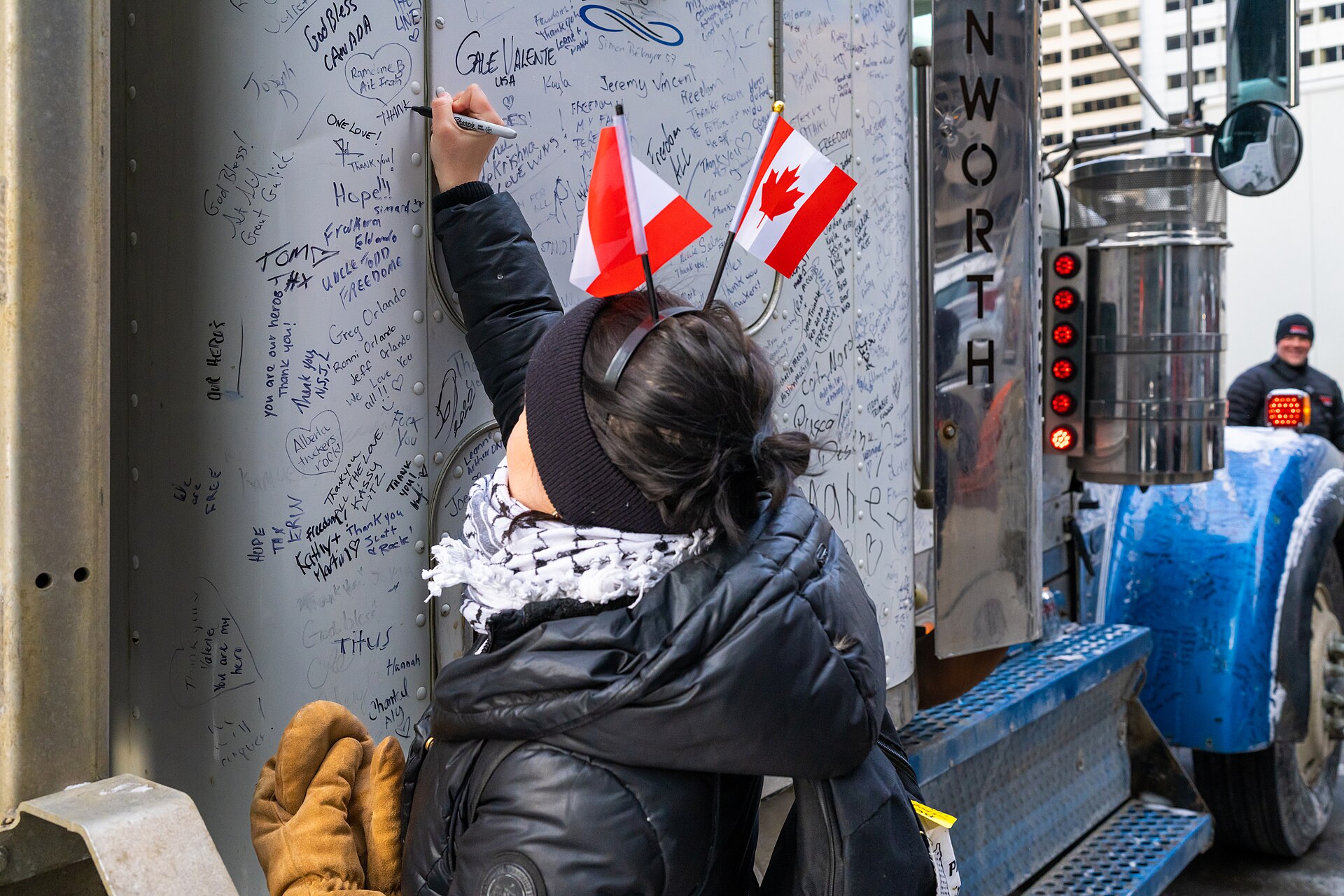
In January 2022, lorry drivers converged on Ottawa to protest against federal vaccine mandates. On 14 February the Trudeau government invoked the Emergencies Act, a law reserved for situations that “seriously endanger the lives, health or safety of Canadians” on a scale no province can handle.
Its predecessor, the War Measures Act, had been used in both world wars and only once in peacetime, by Pierre Trudeau during the October Crisis of 1970 [when a Quebec separatist group kidnapped a British diplomat and murdered a provincial minister]. Ottawa in 2022 was the second peacetime use of such powers.
Under the Act, police cleared the protests by force, public gatherings were banned, protesters’ bank accounts were frozen and crowdfunding sites were barred from handling their money. The EIU marked Canada down on its emergency-powers indicator in the 2022 index.
In January 2024 a Federal Court judge ruled the invocation unreasonable and found that it had infringed the Charter of Rights and Freedoms, Canada’s constitutional bill of rights, including its protections for freedom of expression. The government appealed.
It is worth being precise about cause and effect. Canada’s 0.37-point fall was recorded in the 2021 index, the year before the Act was used, and the EIU put it down to pandemic restrictions in general and to a measurable warming among Canadians towards non-democratic alternatives.
The Act did not cause that fall. Its effect was slower and harder to score: it showed that the power exists and can be reached for. When a rumour spread in 2026 that Prime Minister Mark Carney might use it against Albertan separatists, the rumour proved false, but the fact that it was plausible enough to need denying is the precedent at work.
There is a serious argument that none of this was undemocratic. Thomas Hobbes argued in Leviathan (1651) that people hand power to a sovereign because the sovereign keeps them safe, and that this protection is what makes the power legitimate. Governments everywhere reached for that logic in 2020.
Yet a major comparative study of the period, by Edgell and colleagues, found that emergency measures drifted into violations of democratic standards in a substantial number of countries. Hobbes can justify extraordinary powers during an emergency. He cannot justify keeping them once it is over.
The Populist Dividend
The second casualty was trust. Distrust in institutions drags down two of the index’s five categories, political participation and the functioning of government, and it is the currency populist parties trade in. Populism feeds on distrust, manufactures more of it, and offers someone to blame: in its right-wing forms, most often immigrants.
Two European parties made the restrictions their cause. In 2022 the Alternative für Deutschland (AfD) brought a motion to the Bundestag to scrap Germany’s vaccination requirement for health and care workers. In the Netherlands the Partij voor de Vrijheid (PVV) campaigned against mandatory test certificates and vaccine passports, calling them drastic and disproportionate. The EIU described Dutch voters as frustrated with pandemic restrictions, and the Netherlands lost ground on the index between 2019 and 2021 while Germany held steady.
Here a concession is needed. Neither party was created by the pandemic. The AfD entered the Bundestag in 2017 with 12.6 per cent of the vote, and the PVV has been part of Dutch politics since 2006. What the pandemic offered was a ready-made grievance for parties already in the business of collecting them.
The Dutch case has since turned against the simple story: the PVV won the 2023 election and entered government in 2024, that coalition collapsed in 2025, and at the election that October the party lost heavily to the centrist D66. In Germany, by contrast, the AfD took 20.8 per cent of the vote in February 2025.
Pandemic anger was real, but it was neither permanent nor uniform. The defensible claim is the narrower one: the pandemic accelerated a movement that was already under way. It did not start it.
The Aragalaya
If emergency law and distrust were the costs, protest was the first sign of recovery. The pandemic did not suppress protest; it gave it both fuel and tools. The economic shock hit rich and poor countries alike, and social media use rose sharply, giving movements a way around the broadcasters and newspapers that governments find easier to manage. Demonstrations carried on through the pandemic years, from Black Lives Matter in the United States to months of resistance in Myanmar after the 2021 military coup.
The clearest case is Sri Lanka’s Aragalaya, the Sinhala word for “struggle” and the name its 2022 protest movement gave itself. The crisis behind it is rightly traced to choices made before the virus arrived: deep tax cuts in 2019 that gutted government revenue, an overnight ban on chemical fertiliser imports in 2021 that collapsed rice and tea harvests, and a decade of foreign borrowing for infrastructure.
What the pandemic did was remove the two things paying for all of it: tourism and remittances [money sent home by people working abroad]. The result was shortages of fuel, food and medicine, and a movement that began under the hashtag #GoHomeGota and ended with President Gotabaya Rajapaksa fleeing the country in July 2022.
What happened next is what matters. Sri Lanka’s index score had fallen 0.13 points between 2019 and 2020. It rose 0.33 points between 2021 and 2022 and a further 0.38 by 2025, when the EIU treated the country as a success story of institutional reform, local elections and strengthened pluralism. In November 2024 the National People’s Power coalition won 159 of 225 parliamentary seats, the largest majority in Sri Lankan history.
It is tempting to read the same pattern across the region, but it does not yet hold. Nepal’s Gen Z protests brought down a government in 2025, and Nepal then recorded the steepest democratic decline in its region in the 2025 index, down 0.59 points. Bangladesh, after the student movement that removed Sheikh Hasina in 2024, appears in the same index among the countries with the sharpest setbacks.
The EIU’s own conclusion is the one to keep: participation alone does not consolidate democracy without institutional reform. Mobilisation is the beginning of the story, not the end, and so far Sri Lanka is the only one of these cases where the second half has been written.
Budapest, by the Book
Hungary shows the recovery running entirely through the ballot box. In April 2026 Péter Magyar’s Tisza party won 141 of the 199 seats in Hungary’s parliament, a two-thirds majority and enough to amend the constitution, and Viktor Orbán conceded on election night after sixteen years in power. Tisza had campaigned online and on the ground against a government that had spent more than a decade building what Orbán himself called an “illiberal state”.
Within months the new parliament moved to abolish the Orbán-era Sovereignty Protection Office and wrote an eight-year limit for prime ministers into law, ruling out Orbán’s return.
Some of its other moves, including a shake-up of the prosecution service and a law ending the president’s term early, have drawn criticism from human rights groups, and the objection is a fair one: a supermajority used quickly is a supermajority using the same tools the previous government was condemned for. But the deeper point stands. An entrenched illiberal government was removed by an ordinary election.
What the 2020s Will Be Remembered For
The pandemic was both the sharpest assault on democracy in living memory and the clearest reminder of what democracy is worth. The road towards autocracy began with emergency law, whose precedent outlasts the emergency, as Canada shows, and continued through a collapse in trust that handed populists a ready-made argument. But the same years produced mass movements that toppled governments in Sri Lanka, Nepal and Bangladesh, and a wholly legal change of power in Hungary.
The pandemic was bad for democracy in the short run and may yet prove good for it in the long run: not because the emergency powers were harmless, but because the anger they generated has been turning into votes. There are more full democracies today than in 2019.
That does not vindicate what was done in 2020; it shows that what was done in 2020 was survivable. Whether the 2020s are remembered for democratic renewal or for normalised authoritarianism will depend less on the virus than on whether the generation that grew up under its restrictions decides to write the lesson into law.