The Shirt Off Their Backs
With betting sponsors banned from the front of Premier League shirts, clubs face an £80 million shortfall because sponsors overpaid by around 38 per cent.
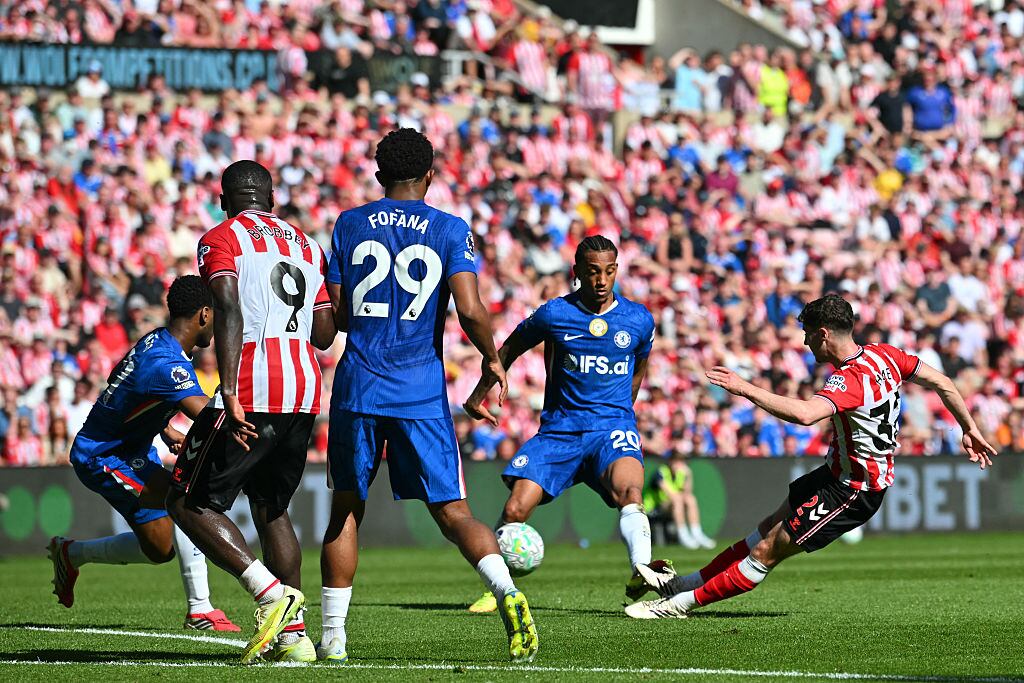

WHEN Fulham walked out for their opening fixture of the 2026/27 season, the sponsor on their chest was ClickHouse, a Silicon Valley data infrastructure company few fans outside the tech industry would recognise. A year earlier, that space had been filled by SBOTOP, an online betting platform and sportsbook. To most fans, the swap looked like nothing more than a new logo. It was, in fact, the visible end of a twenty-year financial arrangement that had quietly become one of English football’s most important revenue streams.
For the first time in the competition’s history, no Premier League club is permitted to carry a gambling company’s logo on the front of its matchday shirt. The clubs agreed to the change voluntarily on 13 April 2023, after an extensive consultation involving the League, its clubs and the UK’s Department for Culture, Media and Sport, and gave themselves three seasons to transition away from existing deals.
That grace period ended with the 2025/26 season. Eleven of the league’s twenty clubs went into that final year with a betting brand on the front of their shirts, and nine of them still had no replacement lined up in the spring. Chelsea, who had already spent stretches of the previous season playing with a blank chest, did not confirm a new front-of-shirt partner, the digital currency firm Circle, until the last days of August.
The change is being described, accurately, as the closing of a twenty-year era. Its unwinding is now exposing just how dependent the Premier League’s middle and lower-tier clubs have become on money that was never quite as solid as it looked. It is worth asking why that era lasted as long as it did, and why ending it is proving so expensive.
A Premium Built on Other People’s Money
Betting sponsorships did not become dominant in English football by accident. Gambling operators were, for two decades, willing to pay significantly more than the usual rate for main sponsor exposure. The Sponsor, a trade publication that estimates the fair market value of every Premier League sponsorship asset each year, calculates that gambling brands paid roughly 38 per cent above that rate for their front-of-shirt deals. Fair market value here means the price an ordinary advertiser would be expected to pay.
The premium was built on the value of global broadcast reach to an industry, particularly operators courting Asian betting markets, for which legitimacy by association with a top-tier English club was worth paying over the odds for.
That premium was not evenly distributed, though. It flowed disproportionately toward clubs outside the traditional “big six” (Arsenal, Chelsea, Liverpool, Manchester City, Manchester United and Tottenham Hotspur, the league’s wealthiest and most globally followed clubs). These were the teams least able to attract prestige sponsors like Emirates or Etihad and most reliant on whatever the market would bear. Not one of the big six carried a betting brand on the front of the shirt in 2025/26.
By that final year before the ban took effect, clubs’ reliance on gambling sponsors had, if anything, intensified rather than faded. The collective value of Premier League gambling shirt sponsorships passed £90 million, a record for the category. That spike looks less like confidence in the category and more like a “closing window” effect: clubs squeezing the last value out of an asset before regulation removed it.
It came at a moment when the league’s profitability and sustainability rules, the limits on how much a club is allowed to lose over a rolling three-year period, were already tightening the margin for error on every balance sheet.
These numbers are the ones that make this a finance story rather than simply a sports ethics one. Clubs were not being subsidised by gambling companies out of generosity. They were extracting a temporary, above-market rent from an industry that needed English football’s audience more than English football strictly needed its money. And they were building that rent into their operating budgets in a league where the gap between staying up and going down runs to tens of millions of pounds a season.
Who Actually Pays for the Ban
The clubs least equipped to absorb the loss are, unsurprisingly, the ones that relied on it most. Analysis by the law firm Shoosmiths puts Brentford’s deal with Hollywoodbets at £3 million of a total commercial income of £15.6 million: a fifth of everything the club earned outside broadcasting and matchdays. Newcastle United’s arrangement with Fun88 was worth £8 million against £28 million of commercial revenue, or 28 per cent.
Commercial revenue, the money a club makes from sponsorship, merchandise and its own brand rather than from television money or ticket sales, is the part of the accounts a club has most control over, which is exactly why a hole in it hurts. For clubs like these, gambling money was structural: a line item that other budgets were built around.
Executives cited by The Guardian have suggested that nearly every club outside the big six stands to lose money on the transition, with offers from non-gambling brands running at around half the value of the deals they replace. One senior executive at a club outside the big six put it plainly: shirt sponsorship offers have dropped by around 50 per cent from a range of between £8 million and £12 million a season. Bournemouth and Brentford both replaced betting sponsors with deals reported at roughly £4 million to £5 million a year. Industry estimates put the league-wide shortfall at around £80 million.
For the big six, this is a rounding error. Their gambling exposure was minimal, their sponsorship market was never dependent on betting premiums, and Arsenal, Liverpool, Manchester City and Manchester United each command £50 million to £60 million a year from their shirt deals.
For clubs fighting to stay in the Premier League, where broadcast revenue alone can be worth the difference between financial health and administration, it is a real structural gap. It arrives at exactly the moment when tighter profitability rules leave no slack in anyone’s finances.
The Money Hasn’t Left the Building
It would be a mistake to read the ban as gambling money exiting English football. It has mostly just moved. The restriction applies specifically to the front of the shirt; sleeve sponsorships, stadium naming rights, digital pitchside advertising and back-of-shirt placements remain entirely permitted.
Everton and West Ham are among the clubs reported to have relocated their existing betting partners from the front of the shirt to the sleeve, and Newcastle’s arrangement with 8Xbet has taken the same route. The sleeve is a smaller asset: The Sponsor puts its average fair market value at £7.2 million, though it is the one placement still guaranteed a television close-up, and the same analysis expects gambling money to push average sleeve values up by as much as 38 per cent now that the shirt front is closed to it.
This softens the blow without removing it. A sleeve deal, even at an inflated price, is worth a fraction of a front-of-shirt deal, so clubs that move their betting partners there recover only part of what they have lost. More importantly, it means the dependency the ban exposed has not been cured. The relationship between club and operator does not change at all; only the square centimetres do. The clubs that relied most on gambling money are still relying on it, now from a smaller and less valuable space.
There is a second, less comfortable complication. Some of the betting brands most deeply embedded in Premier League sponsorship in recent years have operated through companies not licensed by Britain’s Gambling Commission. That distinction matters. Unlicensed operators, largely aimed at markets outside the UK, sit outside the consumer protections that licensing exists to enforce, from checks on whether a customer can afford to lose to rules on how their data is handled.
In May 2025 the Commission warned four clubs (Bournemouth, Fulham, Newcastle United and Wolverhampton Wanderers) that their sponsorship ties to brands run by TGP Europe could leave club officials liable to prosecution if the arrangements continued.
TGP Europe did not run its own betting brands. Instead, it operated betting websites on behalf of overseas companies that put their own names on them, a practice the industry calls a “white label” arrangement. This meant that a brand on a Premier League shirt could reach British fans through TGP’s licence, even though the company behind the brand had no licence of its own.
When the Commission found failures in TGP Europe’s anti-money-laundering checks, it told the company to pay a £3.3 million penalty and overhaul its procedures. TGP Europe surrendered its British licence instead, and left the market on 16 May 2025.
The front-of-shirt ban, voluntary and specific to matchday shirts, does nothing to resolve that deeper issue. In February 2026 the government opened a separate consultation on barring sponsorship by unlicensed operators altogether, regardless of where on the kit the logo sits; Lisa Nandy, the culture secretary, said it was “not right that unlicensed gambling operators can sponsor some of our biggest football clubs”. That consultation is aimed at closing a gap the shirt-front ban was never designed to close, and it has not yet produced a rule.
What the Ban Actually Reveals
None of this makes the Premier League’s decision meaningless. It is, by the League’s own description, the first UK sports league to give up a lucrative revenue category voluntarily for public health reasons. The scale of the problem it is responding to is genuinely contested, but it is not small.
The Gambling Commission’s own 2024 survey of gambling in Great Britain found 2.7 per cent of adults scoring eight or more on the Problem Gambling Severity Index, the threshold researchers use to identify gambling that has become harmful, although the Commission itself cautions that the figure is sensitive to how the survey is conducted.
Football also plays a direct part in how gambling reaches people. A 2020 study led by researchers at the University of Stirling counted 2.75 gambling marketing references for every minute of televised football: roughly one every twenty-two seconds. Removing the most visible advertising space in English sport from that equation is a genuine, if partial, policy achievement, and it did not require government compulsion to happen: the clubs voted for it themselves.
Nonetheless, the financial reaction to that decision tells its own story, one with less to do with gambling than with the architecture of the Premier League’s “middle class”. A competition often described as the richest league in world football contains, beneath that headline wealth, a set of clubs whose day-to-day stability rested on an inflated, temporary and, in some cases, regulatorily precarious revenue stream.
That stream existed precisely because it operated at the edge of what British oversight could reach. Removing it does not create the fragility so much as reveal it. An £80 million shortfall does not appear from nowhere. Nor does a dependency of that size get built without years of clubs treating the gambling premium as a permanent fixture.
In reality, it was a temporary arbitrage, the profit available from a gap in price between two markets. On one side was what English football’s audience was worth to a licensed British sponsor; on the other, what it was worth to a company that needed the association more.
The betting logo is gone from the front of the shirt. Whether the underlying financial dependency goes with it, or simply migrates to the sleeve, the hoarding and the stadium roof, is the more interesting story. So is the still unresolved question of who is licensed to sponsor a Premier League club at all, and both stories are still being written.