The Quantum Gamble
Looks at the quantum computing boom and finds that firms with working hardware are a fair risk, while firms that only sell a promise are a bet on a story.
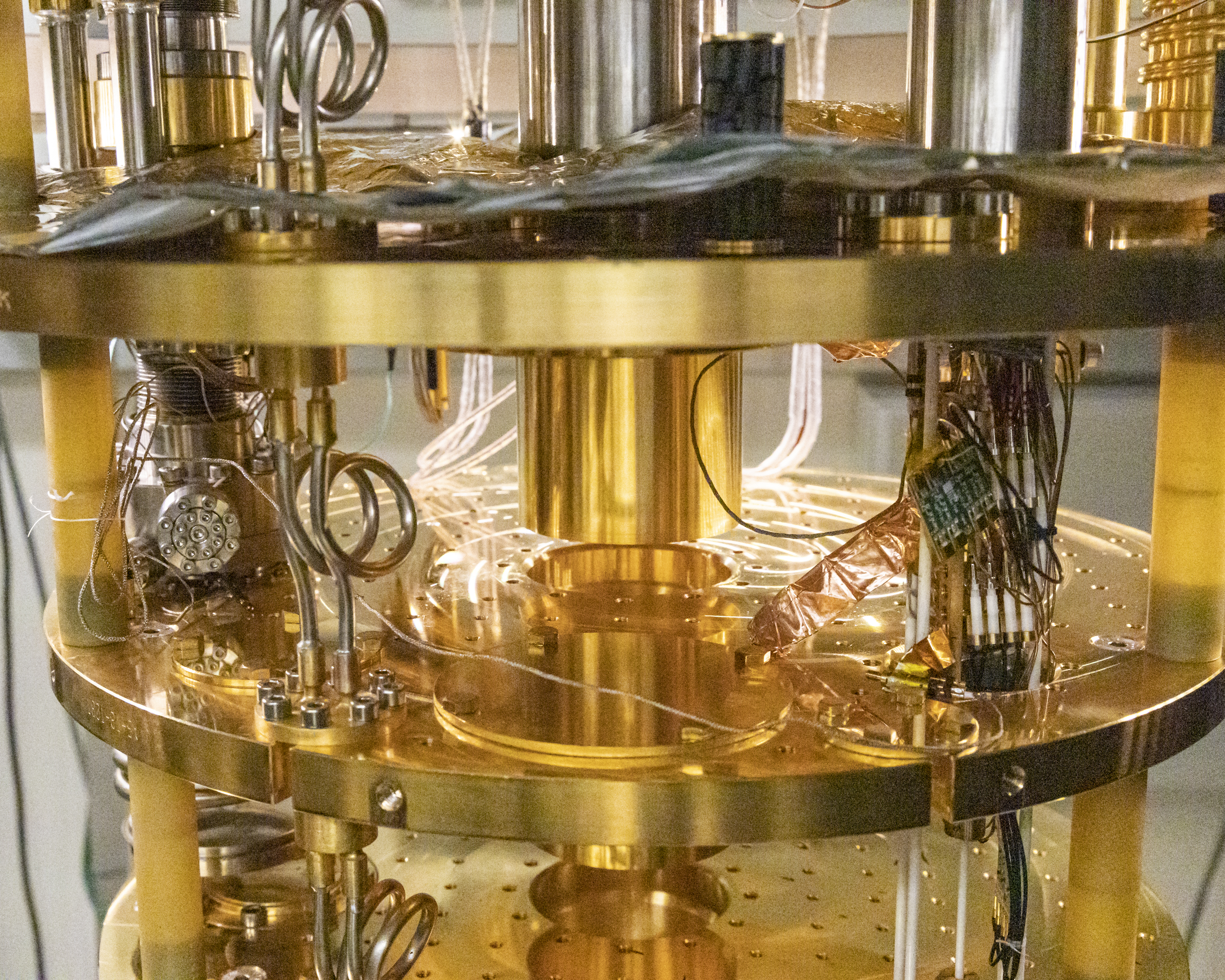

IN the autumn of 2025, BlackRock led a billion-dollar funding round into a company that has never sold a working commercial product to a paying customer at scale, has no clear date for when it will, and operates in a field where the underlying physics still occasionally embarrasses its own engineers. The company was PsiQuantum, valued at roughly $7 billion. Nobody involved seemed to think this was strange. That, in miniature, is the story of quantum computing investment in the mid-2020s: enormous sums, genuine technical progress, and a persistent, nagging question of whether investors have simply forgotten how to price uncertainty.
The numbers alone are dizzying. By The Quantum Insider’s count, venture capital flowing into quantum computing reached roughly $4.9 billion in 2025, more than double the previous record. Across the five quarters to the second quarter of 2026, one tally of the sector’s fundraising records 47 significant financing deals worth a combined $6.3 billion – though the ten largest rounds accounted for over three-quarters of that total, a concentration that says as much about investor nerves as investor enthusiasm. When people are only comfortable writing very large cheques to a very small number of companies, that is not exuberance; it is caution wearing exuberance’s clothes.
This is worth dwelling on, because the easy narrative – reheated dot-com mania, dressed up in qubits – does not quite fit the facts. Quantum computing has already lived through one genuine hype cycle, roughly from 2018 to 2020, when the word “quantum” alone was sufficient to loosen a venture capitalist’s chequebook. That cycle collapsed under its own vagueness.
What followed, from 2022 to 2024, was a colder, more sceptical period in which investors demanded evidence: working hardware, published benchmarks, credible technical roadmaps rather than credible-sounding ones. The money that has poured back in since 2025 arrived only after that filtering process, which is a meaningfully different phenomenon from naive euphoria, even if it produces headlines that look similar.
The Revenue Question
The most persistent criticism of quantum computing as an asset class has always been simple: it does not make money. That criticism is no longer entirely true, and the exception matters more than its size suggests. IonQ, which builds quantum computers by trapping individual charged atoms and manipulating them with lasers, reported $130 million in revenue for 2025, a rise of 202% on the year before – the first time any publicly traded quantum computing company had cleared $100 million in annual audited revenue. It closed the year with $3.3 billion in cash and investments.
It followed this with record revenue in the first quarter of 2026 and raised its full-year guidance twice, first to $260 – 270 million and then, in early August, to $280 – 290 million. It also used a mixture of cash and its own richly valued shares to buy the semiconductor foundry SkyWater Technology for around $1.8 billion – a vertical-integration move, bringing chip manufacturing in house rather than buying it in, that would have seemed premature, even delusional, three years ago. The deal completed in the summer of 2026, and in September the company raised its guidance a third time, to $450-460 million.
That last revision deserves a moment, because it cuts against the headline it generated. Almost the whole of the $170 million increase appears to come from SkyWater’s foundry business, which makes ordinary chips for ordinary customers; the guided quantum revenue was left roughly where it had been. A company can appear to have doubled in size while selling exactly as much quantum computing as it did the month before. It is a useful warning about how carefully the numbers in this sector need to be read – including the ones that flatter the bullish case.
None of this means IonQ’s technology has crossed the threshold that physicists call quantum advantage – the point at which a quantum machine does something no ordinary computer could do in any reasonable amount of time. It has not, and neither has anyone else’s, on any commercially relevant task.
Claims of advantage certainly exist: Google’s random circuit sampling experiments from 2019 onwards, later and larger versions from Chinese groups and from Quantinuum, and a contested set of claims from IBM during 2026, one of which drew a classical rebuttal within weeks demonstrating that the same task could be completed on conventional hardware in well under an hour. But the demonstrations that survive scrutiny are all of deliberately contrived problems. Random circuit sampling, as one survey of the field put it, does not optimise anything, simulate a molecule, or break encryption. When researchers in the field were polled at recent meetings, fewer than half thought quantum advantage had been convincingly demonstrated at all.
What the revenue figures mean, then, is that a market has emerged for quantum hardware and cloud access well before that threshold was reached – sold, in effect, as a bet on future capability rather than present utility. Whether that is a sound way to build an industry or a way to postpone a reckoning is precisely the question dividing serious observers.
Where the Caution Lives
Look closely at where the money is actually going, and a more disciplined picture appears than the top-line figures suggest. Roughly nine-tenths of quantum computing funding is going towards companies that build physical processors, rather than the software and middleware layers – the connecting code that sits between a machine and the programs run on it – that proliferated, and mostly failed, during the first hype cycle.
Silicon-based approaches, which promise to piggyback on decades of existing semiconductor manufacturing infrastructure, have drawn a cluster of well-funded companies in Europe and North America pursuing a specific technical bet: that the cheapest path to a useful quantum computer runs through the same fabrication plants already used to make ordinary chips, rather than through the exotic superconducting or trapped-ion architectures that dominated the previous decade of research funding.
The investor base has also shifted in a way that rewards scrutiny rather than punishing it. Early quantum rounds were the preserve of specialist deep-technology venture funds willing to make long-horizon, high-conviction bets that generalist investors would not touch.
The last two years have brought in sovereign wealth funds – state-owned investment vehicles – large asset managers, and, perhaps most tellingly, corporate strategic investors: chipmakers, cloud providers and defence contractors who are not investing for a speculative return in fifteen years but because they need to know, for their own operational reasons, whether this technology will matter to their business in five.
In September 2025, Nvidia’s venture arm funded three separate quantum hardware companies – Quantinuum, PsiQuantum and QuEra – within a single week, covering all three major hardware approaches at once. It is not chasing a narrative; it is hedging a supply-chain risk. That is a different, more sober kind of capital than the retail enthusiasm that inflated the bubble of 2018.
The Honest Counter-Argument
None of this should be mistaken for a case that the sector is safely, boringly rational. McKinsey’s 2026 estimate that quantum computing could generate between $1.3 trillion and $2.7 trillion in economic value by 2035 is the kind of figure that ought to make any careful reader suspicious rather than reassured – not least because a range that wide is an admission in itself, and because a nine-year forecast on an emerging technology is, more often than not, an exercise in confident guessing rather than analysis. The upper number is the one that reaches the headlines.
The core engineering problem has not gone away either. Today’s quantum processors remain noisy, prone to error, and limited in the number of reliable logical qubits they can sustain. A logical qubit is the useful unit: a single stable unit of quantum information stitched together out of many error-prone physical ones, so that the errors cancel rather than accumulate.
Building enough of them is the actual bottleneck standing between the current state of the art and commercially transformative applications in chemistry, logistics or cryptography, and no amount of capital removes it directly. Vendor counts put more than a hundred quantum computing systems in operation worldwide across industrial, educational and cloud platforms, though that figure is a generous one, since it takes in small desktop machines sold for teaching alongside serious research hardware.
More than three hundred companies are already actively working with quantum technology vendors. But experimentation is not the same as dependency, and dependency is what ultimately justifies a valuation.
There is also a structural risk that is rarely discussed in the trade press: concentration risk within the investor base itself. When three-quarters of a sector’s capital comes from ten deals, and those deals increasingly come from strategic players with their own commercial incentives rather than financial investors seeking the best risk-adjusted return, the sector’s continued funding becomes partly hostage to the strategic priorities of a handful of large technology companies.
Should a single hyperscaler – one of the giant cloud operators such as Amazon, Microsoft or Google – decide that in-house research suits it better than external investment, a meaningful share of the sector’s oxygen could disappear quite suddenly. It is a vulnerability that a more diversified capital base would not share.
A Synthesis, Not a Verdict
The honest answer to whether quantum computing is a hype cycle or a genuine investment opportunity is that the framing itself is slightly wrong. It presents a binary choice where the more useful description is a bifurcation.
At the hardware frontier – companies with working, shippable machines, growing paid revenue and defensible technical roadmaps – the investment case increasingly resembles that of any capital-intensive, early-commercialisation industry: semiconductors in the 1970s, perhaps, or biotechnology in the 1990s. Genuine uncertainty, genuine risk of failure, but not irrational.
Further from that frontier, among companies whose pitch still rests more on the promise of the technology than on demonstrated commercial traction, the old critique holds up rather better. Capital there is still substantially a bet on a narrative, dressed in the borrowed credibility of the sector’s more advanced players.
Investors who cannot tell the difference between the two categories – and plenty still cannot – are the ones most likely to be remembered as this decade’s cautionary tale. Those who can are positioned to be early into what may, eventually, be a genuinely transformative industry. The physics will decide which group turns out to have been right; the capital, for now, is simply making its bet in public.