Conditional Fragility
Looks at what happens when AI trading algorithms hit a commodity futures market under stress, and which circuit breakers actually stop the damage.
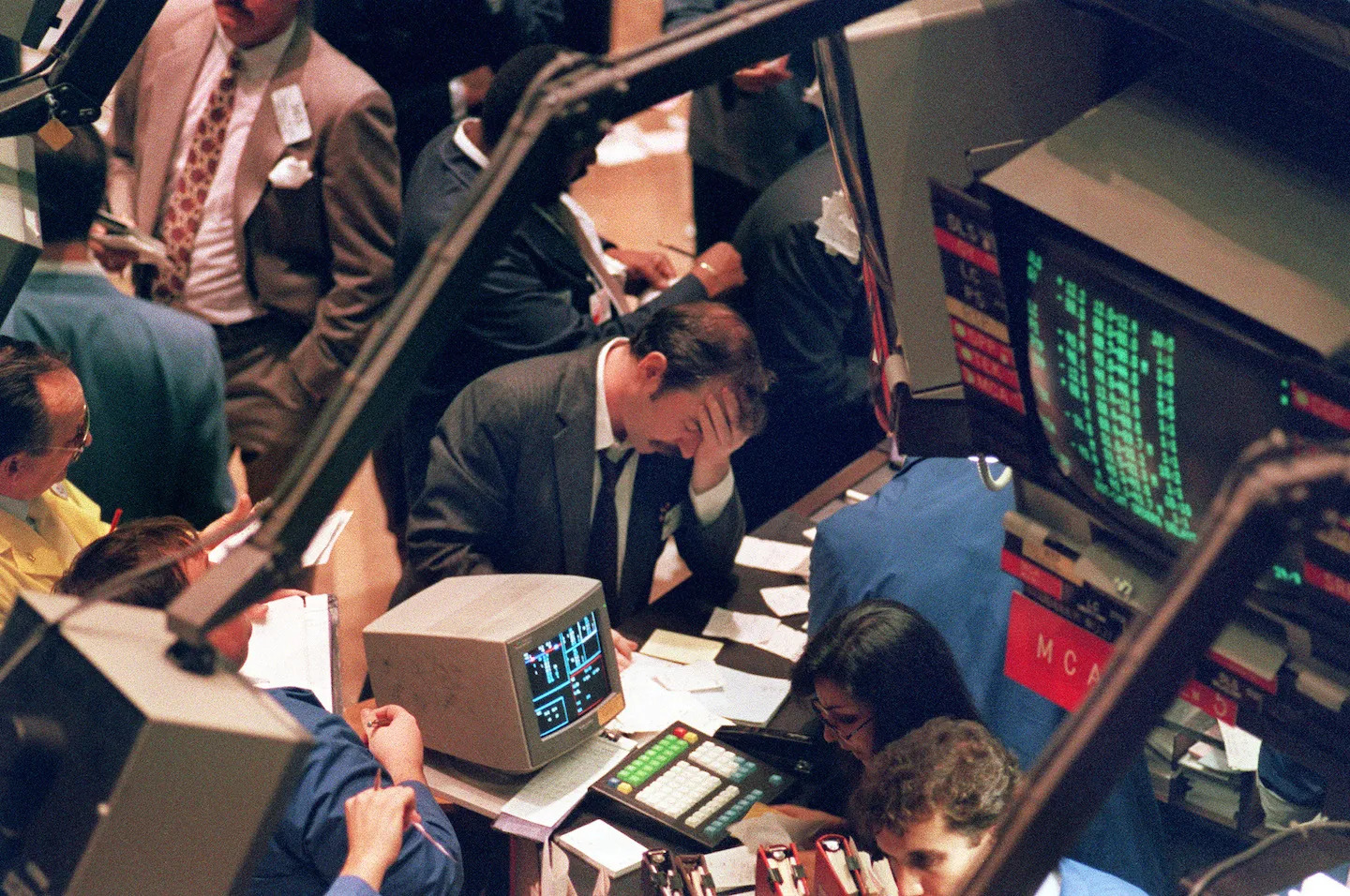

COMPUTERS now do most of the trading in many financial markets. They react in millionths of a second, far faster than any person. This speed brings real benefits: trading is cheaper, and prices update quickly. But it also creates a new kind of danger. In 2012, a software error at Knight Capital, then one of the largest trading firms in the United States, fired off millions of unintended orders. In about 45 minutes, the firm lost roughly $440 million, even though nothing was wrong with the market itself. The system simply did what its broken code told it to do.
This piece asks what happens when that technology, now increasingly powered by artificial intelligence, meets extreme conditions in commodity futures markets, and which safety mechanisms best prevent failure. Commodity futures are contracts to buy or sell raw materials such as oil, natural gas, wheat or gold at a set price on a future date. These markets matter to everyone, because they help set what people pay for food and energy.
Two terms need precise meaning before the argument begins. Extreme market conditions, here, are short periods when prices move far outside their normal range: a one-day move several times larger than the recent average, a price that reaches an exchange’s official limit, or an event that triggers a trading halt. Market failure means an operational breakdown rather than the textbook economics term – episodes in which a market temporarily stops doing its two basic jobs, discovering prices and letting people trade at reasonable cost. Flash crashes, the sudden disappearance of liquidity, and disorderly halts are the clearest examples, especially when the distress spreads to related markets.
“AI-driven” needs equal care, because automated trading spans three tiers. The first is rule-based algorithms that execute fixed instructions, such as splitting a large order into smaller pieces. The second is machine-learning-augmented systems, in which statistical models generate trading signals but the strategy itself is fixed by human designers. The third is autonomous learning agents, such as reinforcement-learning systems, which adapt their own strategies from data.
Much of the evidence that follows concerns the first two tiers, and high-frequency trading in general; direct evidence on the third remains scarce. The channels described below should strengthen as one climbs that ladder: the more systems learn from similar data, the more correlated their behaviour becomes, and the faster they act, the faster errors travel.
The argument rests on a single idea: conditional fragility. AI-driven high-frequency trading – automated trading at very high speed – is neither good nor bad by itself. Whether it calms a market or breaks it depends on conditions that can be named and studied. Safety rules, in turn, only work when they match those conditions.
Why the Tool-Versus-Threat Debate Misses the Point
Research on AI in trading looks divided. One group of studies shows the technology performing well. Massahi and Mahootchi build a self-teaching trading program, based on deep reinforcement learning, that trades volatile commodity futures while keeping profits steady and losses controlled. Gao and his co-authors show that a prediction signal built with ChatGPT forecasts commodity futures returns, and keeps working as economic conditions change.
Another group shows harm. Breckenfelder finds that when high-frequency traders compete with one another, they shift from supplying liquidity – the ability to buy and sell easily – towards speculative bets, and market quality gets worse. Danielsson and Uthemann build a model in which AI makes financial crises faster and more severe.
Conditional fragility explains why both groups can be right: they study different situations. The first tests one system trading in its environment. The second studies many systems interacting under stress. Evidence on ordinary algorithmic trading points the same way. The foundational study by Hendershott, Jones and Menkveld found that algorithmic trading improves liquidity, while Karkowska and Palczewski show that the measured effect can flip from positive to negative depending on how liquidity is measured. The useful question is not whether AI is good or bad for markets, but under what conditions it flips from helpful to harmful.
Three Channels of Failure
Recent research suggests three channels through which AI-driven high-frequency trading can turn an ordinary shock into a market failure.
The first is crowding. Automated systems are often trained on similar data and chase similar signals, so under stress they tend to act alike. Breckenfelder finds that competing high-frequency traders traded on the same side of the market in roughly seventy per cent of five-minute intervals. Danielsson and Uthemann describe this as the essence of AI-driven fragility: many independent systems converging on the same action at the same moment, which turns an ordinary price move into a one-sided rush for the exit.
The second channel is liquidity withdrawal. Market-making algorithms are designed to profit from small, predictable price movements, and they are built to step back the moment volatility rises beyond their models’ comfort zone. That is individually rational – no firm wants to keep buying into a falling market – but collectively it removes exactly the liquidity that would otherwise cushion a shock, and prices move further than the underlying news alone would justify.
The third channel is error spread. Because markets are interconnected, an error or a shock in one market travels quickly to related ones through arbitrage algorithms that trade the price difference between them. The China 2016 example is instructive: a circuit breaker introduced to calm the Shanghai and Shenzhen exchanges was itself blamed for accelerating the sell-off, because traders raced to sell before the breaker triggered a second time, and the mechanism was suspended after only four trading days.
Matching Safeguards to Failures
Three types of safeguard are commonly proposed: circuit breakers that halt trading once prices move beyond a threshold, kill switches that automatically shut down an individual firm’s algorithm if it behaves abnormally, and position limits that cap how much any one participant can hold.
Evidence on circuit breakers is genuinely divided: some studies find they give the market time to absorb information and prevent panic, while others – including the 2016 Chinese case – find they can create a “magnet effect”, in which traders rush to sell before a price limit takes effect, making the very outcome the breaker was meant to prevent more likely rather than less.
Kill switches address the Knight Capital problem directly, since they are designed to catch a single runaway algorithm before it can do the kind of damage Knight Capital did to itself; they do little, however, against the crowding and liquidity-withdrawal channels, which involve many separate systems each behaving as their design intends.
The three channels identified here point toward what safeguards should target: correlated behaviour, not simply speed. A rule that only limits how fast an individual firm can trade will do little if a hundred different firms’ models all reach the same conclusion at the same moment.
Conclusion
AI-driven trading in commodity futures is neither an unambiguous good nor an unambiguous danger. It is conditionally fragile: safe in ordinary conditions, and capable of turning an ordinary shock into a market failure once crowding, liquidity withdrawal and error spread combine under stress.
The evidence reviewed here suggests that the debate over whether AI belongs in these markets is the wrong debate. The right one is over which conditions make it dangerous, and which of the available safeguards – circuit breakers, kill switches, position limits – actually address those conditions rather than a different problem altogether.
Markets that matter this much to ordinary people, who pay the price of food and fuel that these futures ultimately help set, deserve rules built for the failure mode that is actually coming, not the one that is easiest to legislate against.