Power the Future
Thailand will miss its 2037 renewable energy target unless it pays for battery storage and improves its metering and bidding systems.

IN 2024 the Thai government raised the renewable share it intends its electricity grid to reach by 2037 from 36 per cent to 51 per cent. It is a serious target, and on current form it will be missed. Renewables today supply about 14 per cent of Thai generation. Natural gas supplies well over half. The distance between those two numbers is not a gap in ambition, and it is not a gap in technology – solar panels and batteries are cheaper in Thailand now than at any point in the country’s history. It is a gap in machinery: the country has written down where it wants to go without building the institutions that would take it there.
Thailand needs three pieces of machinery, and it needs them roughly in that order: a market that pays people to store electricity, a metering system that can see what the grid is actually doing, and a bidding process that makes private developers compete to build generation rather than be paid a fixed price for it. None of the three is exotic. Two of the three would cost the Thai state nothing directly. What they require is a government willing to treat 2037 as a deadline rather than an aspiration.
A Grid Built on Imported Risk
Thailand generates the large majority of its electricity from fossil fuels. Natural gas alone supplies between 55 and 58 per cent of total grid generation, with coal contributing a further 15 to 20 per cent – together roughly three quarters of everything the country burns to keep the lights on. This dual dependency creates two distinct problems, and they are worth separating because they have different solutions.
The first is price. Thailand no longer produces enough of its own gas to feed its own power stations, and the shortfall arrives as LNG – liquefied natural gas, gas chilled until it turns liquid so that it can be loaded onto a ship. Imported LNG is projected to rise from roughly 40 per cent of Thai gas supply to 60 per cent by 2035. That is a structural transfer of risk from the global market onto the Thai household bill. When a cargo price moves in Qatar or in Australia, it moves in Bangkok too, and no amount of domestic regulation can stop it. A grid that is three-fifths dependent on a fuel bought at world prices is a grid whose costs are set somewhere else.
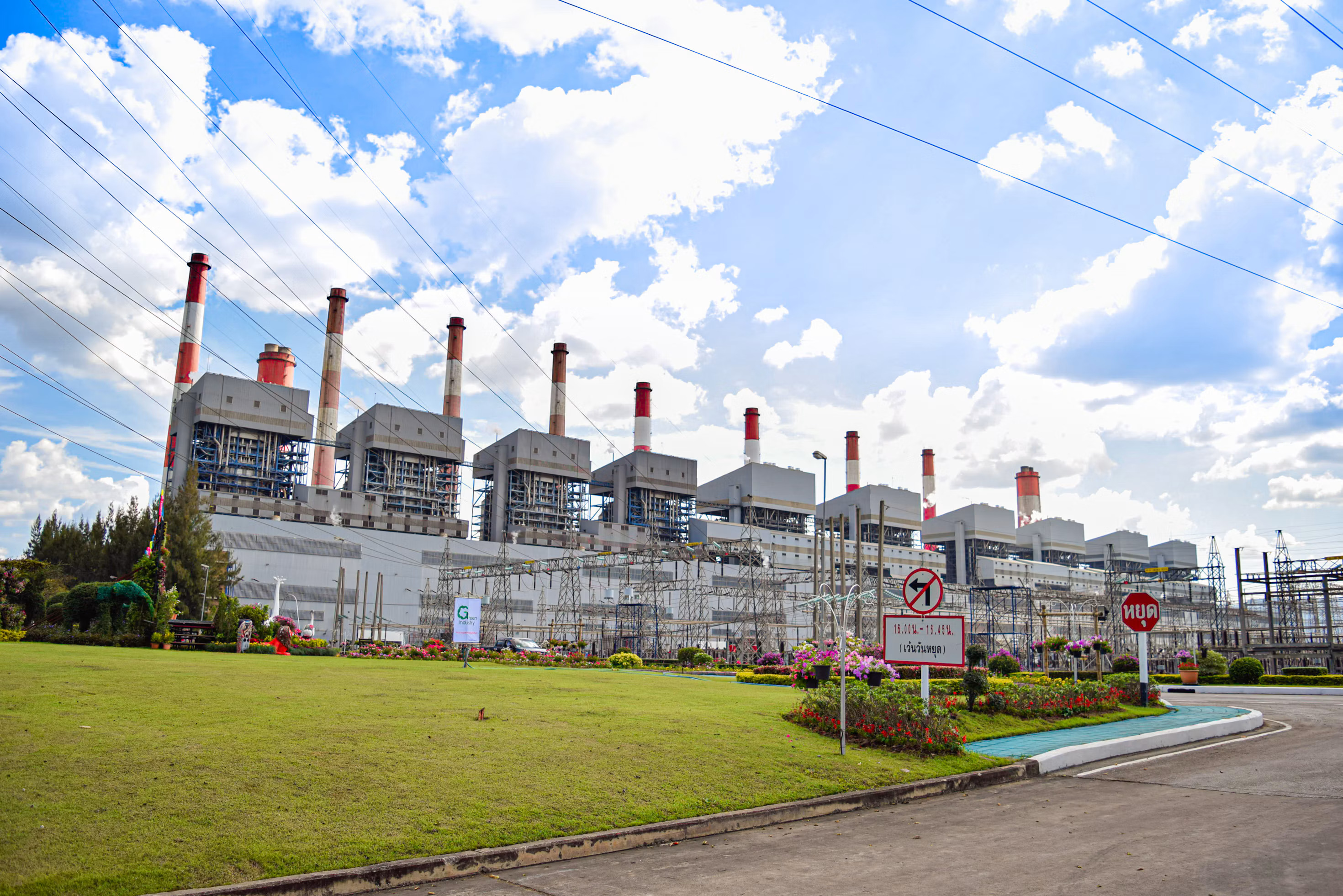
The second is pollution, and the political difficulty of ever switching a coal plant off. Thai coal generation is concentrated at Mae Moh in Lampang province, the country’s largest and most polluting power station, and the retirement date for Mae Moh keeps moving away. Units 8 and 11 were due to be retired at the end of 2025; in August of that year the National Energy Policy Committee extended them to 2031. Units 12 and 13 are to be refurbished and run until 2048.
Each extension is defended as a temporary measure to protect supply security, and each one pushes the cost of the transition onto a later government. Meanwhile low-carbon generation – hydro, wind, solar and biofuel combined – supplies only around 14 per cent of the grid, leaving Thailand’s electricity system both financially volatile and environmentally damaging at the same time.
The Gap the Government Has Already Admitted
The useful thing about the Power Development Plan of 2024 – the document in which the Thai state sets out what it expects the grid to look like over the following decade and more – is that it concedes the argument. It raises the 2037 renewable target to 51 per cent and it envisages roughly 14 gigawatts of energy storage to support it.
The state has therefore already accepted both the destination and the scale of the equipment needed. What the plan does not contain is a procurement mechanism: a repeatable, competitive process through which that storage and that generation actually get built, by whom, and at what price. A target without a mechanism is a press release.
Policy objectives: baseline and 2037 target
| Metric | Baseline | 2037 target |
|---|---|---|
| Renewables (share of generation) | 14–21% | 51% |
| Gas | 55–58% | 25–35% (retained as reserve capacity, not the everyday backbone) |
| Coal | 15–20% | ~5% (held only as a baseload floor) |
| Storage capacity | ~1,600 MW | 14,000 MW |
Storage First
Storage has to come first, because without it every additional megawatt of solar is a megawatt that has to be shadowed by a gas plant. A solar farm produces nothing after sunset, and Thai electricity demand does not stop after sunset. Until the grid can move midday solar into the evening peak, building more solar does not displace gas – it simply adds an expensive second system alongside the one already there. This is the reason renewable share targets stall in the high twenties in country after country, and it is the reason storage, not generation, is the binding constraint.
The instrument already exists in embryo. The Energy Regulatory Commission runs a partial-firm scheme under which solar paired with battery storage receives a higher tariff in exchange for a commitment to deliver power when instructed rather than merely when the sun is out. That pilot should become a permanent annual capacity auction, open to all qualified private developers.
In a capacity auction the state does not buy electricity; it buys a promise to have capacity available, and it awards that promise to whoever offers it most cheaply. Each year the Electricity Generating Authority of Thailand would put a volume of battery storage out to competitive tender and award long-term contracts to the most cost-effective bidder, with procurement targets rising progressively – approximately 2,000 megawatts by year three, 7,000 by year six, and 14,000 by 2037.
Successful bidders would receive capacity availability agreements of 15 to 20 years, long enough for a bank to lend against. In exchange, each facility would be required to maintain at least 60 per cent of its contracted capacity as available during overnight windows, when the solar fleet is dark and the system is at its most exposed, with further performance standards specified by the Commission in the bidding terms of reference.
The point of writing the availability obligation into the contract rather than leaving it to good intentions is that it is what the state is actually buying. A battery that is empty at eight in the evening has not solved the problem it was procured to solve.
The Meter Is the Missing Infrastructure
The second mechanism is the least glamorous and the most quietly decisive. Thailand’s two distribution utilities, the Metropolitan Electricity Authority and the Provincial Electricity Authority, both operate smart meter pilot programmes in limited areas, and neither has begun universal deployment. A smart meter, unlike the spinning disc it replaces, reports consumption continuously rather than once a month when somebody walks past and reads it. That difference sounds administrative. It is not.
A grid carrying a great deal of solar is a grid whose flows reverse during the day, as rooftops export power back into a network originally designed only to deliver it. Managing that requires knowing, minute by minute, what is happening at the edges of the system. It is also the precondition for time-of-use pricing – charging more for electricity at the evening peak and less at midday – which is the cheapest tool any government has for shifting demand into the hours when renewable output is abundant. Without meters, none of it is available.
This mechanism should therefore expand the existing pilots into a nationwide advanced metering infrastructure programme covering every Metropolitan and Provincial Electricity Authority account, on a three-phase rollout: first the Bangkok Metropolitan Area and the Eastern Economic Corridor, then secondary provincial centres, then full national coverage by 2037.
Implementation should remain government-led, because electricity metering and consumption data constitute a core public utility function and the record of who consumed what, when, is not a dataset that should sit with a private contractor.
Letting Developers Take the Risk
The third mechanism concerns generation itself, and it turns on a choice between two ways of paying for it. Thailand currently uses a feed-in tariff: an administered price, fixed by the regulator in advance, that any qualifying project receives for every unit it generates. Under the 2022 scheme that price is 2.1679 baht per kilowatt hour for ground-mounted solar and 3.1014 baht for wind. The weakness of an administered price is that the government has to guess it, and a government that guesses too high overpays for twenty-five years.
The alternative is to make developers bid against each other and let the price be discovered rather than declared. The proposal is a 25-year Build-Own-Operate contract – a structure in which the private developer, not the state, is responsible for land acquisition, project development, construction, grid interconnection and operation, and carries the risk if any of them goes wrong.
The government, through the Electricity Generating Authority, purchases all the electricity produced under an energy-only power purchase agreement, a long-term contract to buy output at an agreed price, while financing the core transmission work that connects the project to the network. Projects would be awarded through competitive auction rather than fixed tariff, with a reference price ceiling of 2.06 baht per kilowatt hour for solar and 2.45 baht for onshore wind – in both cases below the current administered rate, which is the entire point of holding an auction.
A representative 100-megawatt project requires an estimated capital investment of around 4,000 million baht, or roughly 120 million US dollars, none of which appears on the government’s balance sheet.
Ten-year implementation timeline
| Phase | Year | Milestones |
|---|---|---|
| Start-up | FY2027 (Year 1) | Memoranda of understanding signed; first phase of smart grid rollout begins. |
| Phase One | FY2029 (Year 3) | 2,000 MW of storage procured; 30% smart grid coverage; first renewable auction round. |
| Phase Two | FY2032 (Year 6) | 7,000 MW of storage; 70% smart grid coverage; renewables reach ~40% of grid share. |
| Phase Three | FY2036–2037 (Year 10) | 14,000 MW of storage; full national smart grid coverage; 51% renewable target met. |
Who Pays
The fiscal cost of all this is concentrated almost entirely in the metering programme, at an estimated 160,000 to 180,000 million baht, or 4.7 to 5.3 billion US dollars. Only part of that is actually committed. The Thai cabinet’s May 2026 emergency borrowing decree set aside 400 billion baht overall, and in August the Deputy Prime Minister and Finance Minister, Ekniti Nitithanprapas, confirmed that 200 billion baht of it is prioritised for the clean energy transition broadly – grid modernisation, net metering facilities and smart meter replacement together.
The portion specifically allocated to rooftop solar and smart-grid metering is roughly 50 to 60 billion baht, about a third of what the metering programme actually needs. The remaining balance would have to come from the two distribution utilities’ own capital expenditure budgets – a gap the government has not yet said how it will close.
The storage and generation mechanisms, by contrast, require no direct government spending at all. Both are funded through electricity tariffs paid by consumers and recovered through the availability payment and power purchase agreement components already built into Thailand’s tariff structure.
This is worth stating plainly, because the usual objection to an energy transition is that the country cannot afford one. Two of these three mechanisms are not a spending programme. They are a redirection of money the Thai electricity consumer is already paying – currently, in large part, to buy imported gas.
The Cost of Waiting
The 51 per cent target is not the hard part; the government has already signed it. The hard part is that every year the machinery is not built, the alternative gets built instead. Mae Moh’s units were supposed to close in 2025 and will now run to 2031 and 2048, because when the storage and the auctions do not exist, keeping an old coal plant alive is the only answer available to a minister who has to guarantee supply next winter.
That is what a target without a mechanism produces: not failure announced, but failure deferred, one extension at a time, until the deadline arrives and the grid looks much as it does today.
Thailand has the plan, the money and, increasingly, the prices on its side. What it has not yet built is the set of institutions that would convert those advantages into megawatts. Storage auctions, a national metering programme and competitive generation tenders are unglamorous instruments, and none of them will make a headline. They are, however, the difference between a country that reaches 51 per cent by 2037 and a country that explains, in 2037, why it did not.