Resource-Rich?
Looks at Asian mining countries and finds they actually do better on quality of life than non-mining ones, suggesting what matters is who controls extraction.
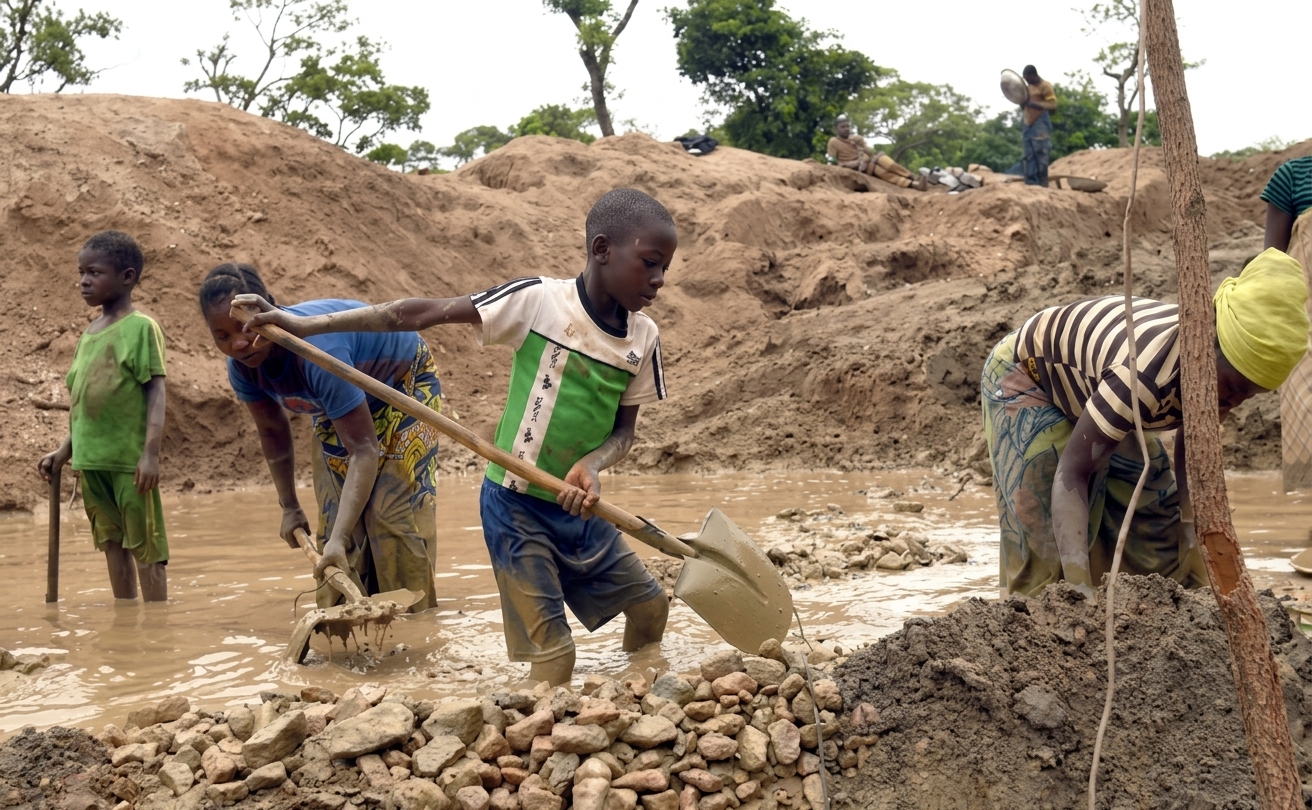

THE phone, tablet, or laptop you are reading this on was built with cobalt mined thousands of kilometres away. The Democratic Republic of Congo is a major supplier of cobalt worldwide, yet the country is severely affected by its own mining industry – with dangerous working conditions, unpaid workers, and documented use of child labour. Even major companies like Apple have been linked to minerals sourced from illegal mines. This is the resource curse in its most visible form, and it was the motivating question behind this analysis.
The resource curse is the paradox by which countries rich in natural resources often end up worse off than those without them. Rather than generating lasting prosperity, resource wealth tends to produce economic dependence on a single extractive industry, weaken other sectors, fuel corruption, and concentrate power in the hands of those who control the extraction. The country extracts the mineral; someone else captures the value. The DRC is the textbook case: mass poverty persists despite an abundance of resources.
The green energy revolution has made this dilemma more urgent. Cobalt, lithium, nickel, copper, and rare earth metals are essential to the technologies we are counting on to save our planet: electric vehicles, solar panels, and wind turbines. But the human cost of extracting them is rarely discussed alongside the climate benefits, and we are not always aware of what’s happening in the mines.
The full list of minerals essential to green energy is long: silicon, silver, indium, copper, nickel, manganese, cobalt, chromium, molybdenum, zinc, lithium, and rare earth metals. If the resource curse holds, the green energy transition may be built on the same foundations of exploitation that have characterised extractive industries for centuries.
This raises an important question: does the resource curse actually apply across Asian mining countries, many of which are central to the green energy supply chain? Asian countries are an interesting example of this possible resource curse, because while some of them are affected negatively by their own resources, similarly to the DRC, some also benefit heavily, showing high quality of life and prosperity, which makes the analysis more interesting. Asian countries were chosen as the focus because they were the most prevalent in global mining lists – and because the contrast within the continent is striking.
To test this, Asian countries involved in extracting key green energy minerals were compared against those that are not, measuring quality of life across three indicators: purchasing-power-adjusted GDP per capita – a measure that accounts for cost of living differences between countries – life expectancy, and education rankings. These categories were chosen to try to paint as broad a picture as possible of quality of life through important metrics. Countries were separated into mining and non-mining groups, and rankings for each category were then compared.
The results were surprising. The initial hypothesis stated that mining countries would have a lower quality of life due to the resource curse, but the final results suggested the opposite – mining countries consistently outperformed non-mining countries across all three indicators, with the non-mining group scoring approximately 14.5 ranking points worse on average. The findings of this study suggest that the relationship between mining and quality of life is not as straightforward and simple as the traditional resource curse theory suggests.
One possible explanation for this finding is that many Asian countries are not solely dependent on their mining industry – other sectors, rather than extraction itself, drive much of their prosperity. China especially is a very interesting example: it appeared in eleven out of thirteen possible mining categories, being responsible for the mining of many different minerals; yet, it is quite economically prosperous, with a GDP second only to the USA. Countries like South Korea, Japan, Malaysia, and Thailand combine mining with industrial production, manufacturing, and technological development. In these cases, mineral extraction exists alongside highly diversified economies, which insulates them from the dependence trap the resource curse describes.
Meanwhile, many of the non-mining countries – Afghanistan, Yemen, Syria, North Korea – suffer from internal socioeconomic issues that drastically decrease their own quality of life rankings, influencing the overall results. Their struggles may reflect political instability, conflict, and governance failures rather than anything about resources at all.
But the most important caveat is one that the data cannot capture: just because a mine is located in a specific country, it is not necessarily the case that the country will be the one benefiting from the mine. Many countries such as Brazil and the DRC have been exploited for their resources since they were colonies – clearly, the resources extracted from the mines would not have been extracted to serve the needs of the Brazilians and the Congolese.
The resource curse, in this sense, may be less about resources themselves and more about who controls them and who captures the value they generate. Asian mining countries like China and South Korea largely control their own extraction and processing industries. That is a fundamentally different situation from a country whose mines are owned by foreign corporations and whose government captures little of the revenue.
There are genuine limitations to this analysis. The sources used could be more academically rigorous, the metrics chosen may not fully capture quality of life, and focusing on a single continent means the results may not translate elsewhere. The initial hypothesis was formed on the basis of an African case study – the DRC – and there is a real possibility that analysing Africa instead of Asia would have produced very different results. Future research should analyse other continents, so that the results are not biased solely through an Asian context, but instead reflect the resource curse globally.
The Asian case suggests that the relationship between natural resources and quality of life is not as straightforward as the traditional resource curse theory implies. Resources are not inherently a curse. The question is who extracts them, who processes them, who owns the infrastructure, and who ultimately benefits. China mines cobalt and builds the batteries. The DRC mines cobalt and remains poor. The mineral is the same. The difference is everything else. Until those structural questions are answered differently in countries like the DRC, the device in your hands will continue to carry a cost that does not appear on any invoice.