A Tale of Two Scottish Cities
Uses Edinburgh's boom and Aberdeen's long-term unemployment, just 92 miles apart, as a case study in how growth clusters around a handful of cities.
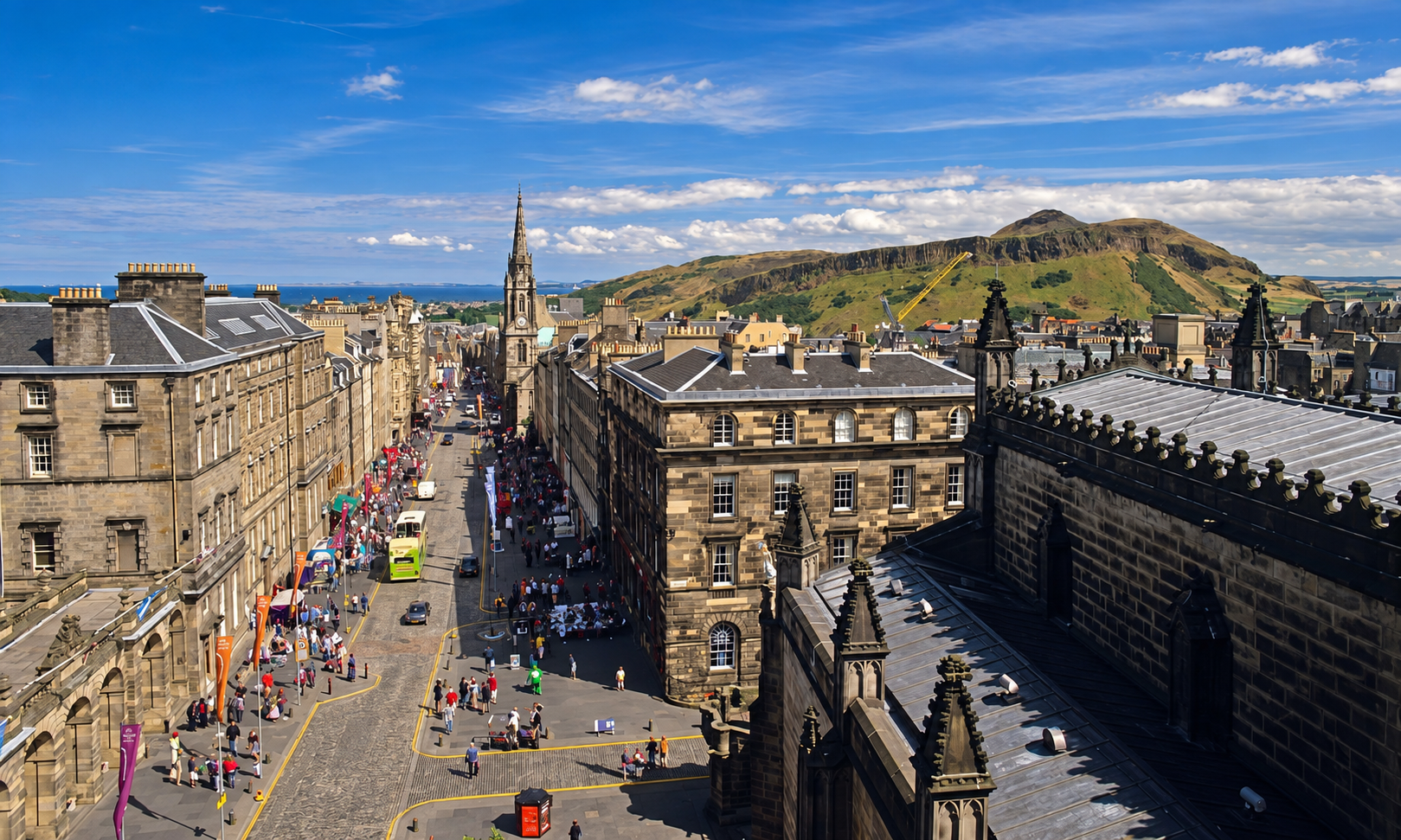

IN economies worldwide, growth has become increasingly concentrated in a small number of diverse, vibrant and prosperous cities. These cities attract investment, foster innovation, and encourage diversity in culture and the arts, thereby ensuring that they continue to receive worldwide attention, global talent and international business. However, this increasing dynamism takes place at the expense of left-behind places – those that have seen neglect due to stagnating wage growth, rising unemployment and falling property prices. The consequences are severe, posing risks to national economic development, social cohesion and democratic politics.
The impact of growing urban dynamism is illustrated by comparing the flourishing city of Edinburgh with Aberdeen, a city just 92 miles away that suffers from structural unemployment – long-term joblessness caused by a mismatch between workers’ skills and available jobs – severe market failure and a loss of skilled workers. Whereas Edinburgh’s average GDP per capita has recently overtaken that of London, Aberdeen is forecast to see the lowest gross value added (GVA) growth in the UK between 2025 and 2028, alongside negative average household income growth.
Although the fall in oil and gas prices was the initial source of Aberdeen’s decline, it was the increasing dynamism of Edinburgh that really led to Aberdeen being unable to rebound like other cities across the globe.
The Success of Edinburgh
Edinburgh is Scotland’s economic powerhouse, home to institutions such as the Royal Bank of Scotland and Baillie Gifford, as well as several lucrative tourist attractions. the University of Edinburgh, ranked first in Scotland and among the top 30 universities globally, had an estimated economic impact on the UK of £7.52bn in the 2021-2022 academic year alone – a figure that excludes the substantial contribution made by the significant proportion of highly skilled students who choose to begin their careers in Scotland after graduating.
The city’s present economic growth, combined with minimal unemployment – the lowest of any major UK city – and the highest volume of Scottish business investment in 20 years, places Edinburgh in a strong position to take advantage of emerging industries such as AI research and development, where it is already a leader.
Economics aside, young people simply love Edinburgh. Life in this multicultural city is rich and varied, and Edinburgh is frequently ranked among the highest performing cities in the UK for its living and working conditions. It is also home to the world’s largest performing arts festival, the Edinburgh Festival Fringe, which sold 2.6 million tickets to a global audience in 2025.
The fact that 76% of graduates that remain in Edinburgh for at least 15 months post-graduation confirms that this is a thriving urban metropolis with strong social, economic and cultural foundations. The highly skilled, productive workforce attracted to the increasingly dynamic city incentivises business investment to flow into Edinburgh at the expense of other Scottish cities, which, as a result, are overlooked.
One such city is Aberdeen.
The Demise of Aberdeen
Historically the oil capital of Europe, Aberdeen at one time looked to have a prosperous future. Between 2004 and 2009, average household incomes rose by nearly 25%, and in 2010 Aberdeen had the UK’s sixth highest average disposable income of any primary urban area. The city experienced strong wage growth, high investor confidence, and accelerating business investment.
This was not to last. The 2014-2016 global oil price crash led to plummeting profits for firms, causing severe job cuts and widespread structural unemployment. Whilst other cities across the globe rebounded from the crash, interventionist government policies aimed at discouraging fossil fuel extraction in favour of greener alternatives have adversely affected Aberdeen.
The 2022 Energy Profits Levy taxed North Sea oil and gas corporations at an overall rate of 75% – rising to 78% from 2024. The knock-on effects are staggering. Since 2010, Aberdeen has seen a net loss of 18,000 jobs across all industries, constituting approximately 10% of the city’s workforce; real household incomes have fallen by 6.7%; and the retail industry has contracted by 30%. Since 2015, there has been a 13.8% reduction in small and medium-sized enterprises in Aberdeenshire, demonstrating reduced investor confidence. Ironically, even Aberdeen Group PLC (Abrdn), headquartered in Edinburgh, closed its Aberdeen branch in 2024.
Young, educated Aberdonians are acutely aware of the city’s decline, as evidenced by the exodus of this labour force to more promising and more lucrative cities such as Edinburgh: 16% of 20 to 29 year-old Aberdonians relocated between 2010 and 2021. Scottish Government immigration data also reveals Aberdeenshire consistently to be one of the least popular counties to move to, with inward migration well below the Scottish average.
Although there has been a top-down pivot towards economic diversification through an attempted transition towards offshore wind power, this has been of limited success. Despite significant investment, this new industry only generates around 1% of the port’s total revenue. Many previously employed in the oil and gas industry have moved abroad to cities such as Dubai and Doha to take advantage of continuing fossil fuel extraction, while others are left behind due to geographical immobility.
The irony is that the UK then imports liquefied natural gas (LNG) from countries such as the UAE, Norway and Qatar at greater cost, producing more greenhouse gas emissions and rendering the UK dangerously reliant on foreign energy imports.
Edinburgh’s Growth at Aberdeen’s Expense
It might be thought that Aberdeen’s decline is solely attributable to the collapse of the North Sea oil and gas industry and has occurred independently of Edinburgh’s success. Undoubtedly, the oil collapse has played a significant role. However, a significant and often overlooked factor that has materially contributed to Aberdeen’s failings is the increasing dynamism of Edinburgh, and to a lesser extent Glasgow.
Conversations with several Aberdonians suggested that a recurring concern was that since the collapse of the oil and gas industry, a disproportionate volume of government funding has been directed towards other Scottish cities. Since 2014, consumer expenditure has dwindled as companies and individuals chose to relocate, and the government’s £250 million 2016 City Deal proved insufficient to safeguard oil and gas sector jobs, leaving Aberdeen behind in comparison to the Edinburgh and South-East Scotland Region, to which the government committed £1.3 billion just two years later.
Recent government data records that the UK Shared Prosperity Fund (2022-2025) has seen Aberdeen receive £24.6 million less than Edinburgh and South-East Scotland, and an astonishing £58.4 million less than Glasgow. In the UK’s Scottish Growth Fund (2026-2029) initiative, which aims to drive economic prosperity across Scotland, Aberdeen receives zero funding, while Glasgow City and Edinburgh are set to receive £60.9 million and £37.8 million respectively.
The explanation for this disparity in funding ultimately lies in the increasing dynamism of cities such as Edinburgh and Glasgow. Those cities increasingly attract a productive workforce alongside new businesses and private investment, which in turn causes economic and physical growth, which in turn causes the government to allocate significant funding to maximise national economic growth.
Despite the argument that concentrating investment in productive cities will reap national benefits across Scotland, this supposed enhanced national benefit appears minimal: national benefits could have been achieved to a greater extent through a wider spread of investment, given Aberdeen’s enormous potential and its highly skilled workforce that is slowly leaving the country.
As the dynamism of those cities increases, a concerning cycle is created by which cities such as Aberdeen become overlooked as their neighbours continue to prosper. Edinburgh’s increasingly dynamic nature has also prevented Aberdeen from benefitting from Scotland’s ambitious climate goals. Both cities share a desire to become an attractive location for new industries emerging from government investment in green energy.
Edinburgh, as a successful agglomeration economy – a concentration of businesses and talent that reinforces itself over time – is in an optimal position for such firms to establish themselves. Even though the physical infrastructure, such as wind turbines and offshore substations, sits off the Aberdeenshire coast, the majority of project management, consulting and research and development remains in Edinburgh and Glasgow. This is confirmed by the Chief Executive of the Port of Aberdeen, Bob Sanguinetti, who considers the prospect of Aberdeen seeing the benefits of the renewable expansion to be a distant one.
In short, Edinburgh’s ability as a dynamic urban metropolis to attract both government and private investment and harbour new industry comes at the evident expense of Aberdeen, which is left with a declining oil and gas industry and no means to replace it with a viable, lucrative alternative.
Economic, Social and Political Consequences
The increasing dynamism of cities such as Edinburgh at the expense of cities such as Aberdeen poses significant economic, social and political risks. Greater focus on vital programmes preventing the occupational and geographical immobility of the Aberdonian workforce would reduce unemployment. An increased allocation of funding to Aberdeen would allow the scaling up of retraining programmes and wind farm management services. And a less centralised focus on Edinburgh’s agglomerative economy would have directed a greater proportion of Scotland’s private sector investment northward.
Alongside the short-term risks of unemployment, limited GVA growth and weak energy security, significant long-term sociopolitical impacts are beginning to affect Aberdeen, Scotland and the wider United Kingdom.
Demographically, data from Aberdeen City Council projects a growth in the elderly population of 16.1% between 2018 and 2028, alongside a 7.2% fall in the 15 to 29 year-old working population. A strained dependency ratio – the proportion of non-working to working residents – puts further pressure on public services, and with increasingly few skilled employees to work in those services, Aberdeen will inevitably suffer.
There is also a growing perception of social inequality amongst inhabitants of what was once Northeast Scotland’s powerhouse, which risks manifesting as social disorder.
Most significantly, the increasing dynamism of cities such as Edinburgh is causing residents in cities such as Aberdeen to change their voting patterns. Polls and conversations with Aberdonians gave the impression that residents broadly oppose the importation of oil and gas from abroad and would much rather continue extraction in the North Sea.
Their frustration is manifesting in changing political opinion, shifting the nature of democratic politics in Scotland as energy policy becomes a central voting issue. The Scottish National Party is losing seats to Labour and Conservative councillors, and in the coming years there is likely to be a gradual shift towards increasingly polarised parties whose policies either involve continuing oil and gas extraction indefinitely, or favour rapid renewable energy expansion in a way that will benefit Aberdonians.
Conclusion
The increasing dynamism of cities such as Edinburgh, driven by investment, high-skilled workers and cultural power, has reinforced those cities as world-leading urban metropolises. Meanwhile, left-behind places such as Aberdeen, once Scotland’s industrial powerhouse, have faced the loss of highly skilled workers, decelerating GVA growth, and government neglect.
While the initial cause of Aberdeen’s decline may have been the shift away from oil and gas, Edinburgh’s dynamism has undoubtedly accelerated the divide by attracting both government and private investment. The parallel with Sheffield and Detroit – cities that experienced a similar sectoral shift – is instructive: in each case, the increasing dynamism of neighbouring cities proved a major underlying reason for their decline, compounding what might otherwise have been a manageable transition. Aberdeen, the once-glistening Granite City, deserves better than to be left behind.