Two Passions, One Question
A Colombian economist who once played football applies economics to pressure in sport and advises people to do work they enjoy.
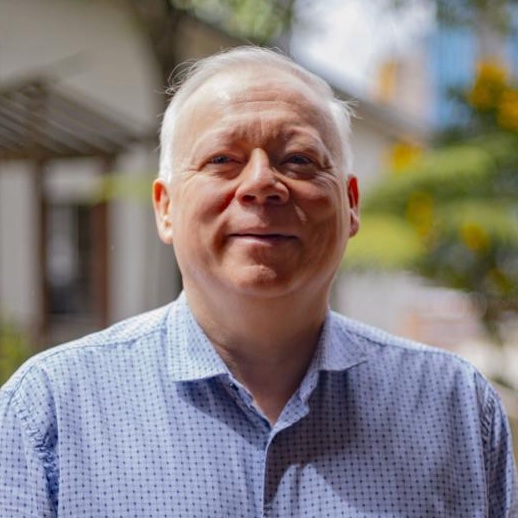
DR. Tovar is a Colombian economist in the Economics Department at Universidad de los Andes, where he has taught since completing his PhD at UC Berkeley roughly 22 years ago. He has been a visiting professor at Wisconsin-Madison and Stanford, and his work spans international trade, industrial organization, economic history, and, more recently, sports economics.
The Confluence: Could you give us a brief introduction to your background and research interests?
Dr. Tovar: I’m Colombian. I studied in Spain as a kid, and even earlier than that I was in England, because my father was doing his PhD at Oxford. I came back to Colombia for university, then moved to Berkeley for my PhD, which I finished about 22 years ago, and joined the Economics Department at Universidad de los Andes, where I’ve been ever since, along with visiting stints at Wisconsin-Madison and Stanford.
My core areas from my PhD are international trade and industrial organization, the study of markets, but I also do a lot of economic history, partly pushed by my father, who’s a historian, we actually co-wrote a book years ago on the freedom of slaves in Colombia. For the past twelve years or so I’ve also taught a class on sports economics.
The Confluence: You’ve written about how professional footballers perform under pressure, including a paper on emotions and performance at the World Cup. Does big-stage pressure make players worse, or better?
Dr. Tovar: That’s a joint paper with a Spanish professor at the University of Liverpool. The idea is to understand how pressure affects people, and the beauty of sports data is that you can measure performance minute by minute, which is very hard to do in most professions. Using very detailed World Cup data, we asked: what’s the biggest shock in a football match? A goal. So do players change their performance after a goal, relative to how they were playing before it? That’s what the paper looks at, using a lot of statistics and econometrics to understand how professional workers perform under pressure.
I played football quite seriously when I was young, even at what would be second-division level here in Colombia, with Millonarios, before retiring like a lot of frustrated players do. So this work lets me combine my two passions, economics and football. It’s not that it’s an easier question, it’s just more fun to answer economic questions through the lens of something I love.
The Confluence: You’ve also written a book on El Dorado and Colombian football. What’s the story there?
Dr. Tovar: El Dorado in Colombia refers to a period from the 1500s onward when the Spanish, hearing about gold jewelry among indigenous communities, went looking for a mythical golden city that never actually existed, they even tried draining a lake in the twentieth century looking for it. It turned out El Dorado wasn’t one place, but really the whole gold-rich territory of Colombia.
The connection to football is that Colombia’s professional league started in 1948, and from 1949 it suddenly began attracting the best players in the world and paying huge sums, so the press at the time started calling it football’s own El Dorado. Plenty had been written about it by journalists focused on storytelling, but nobody had really studied why it happened from a social or economic angle, which is striking, because the league was only a year old when it became globally significant.
I worked on that with my colleague Andres Alvarez at Los Andes, an economic historian, we wanted to understand what actually made that remarkable league possible, not just retell a good story.
The Confluence: You’ve also studied how Colombian exporters survived a collapse in trade with Venezuela. What determines whether a firm keeps exporting through a shock like that instead of being wiped out?
Dr. Tovar: That came out of tensions between Colombia’s President Uribe and Venezuela’s Hugo Chavez, after reports, which turned out to be exaggerated, that the US would build a military base in Colombia. Chavez cut economic relations entirely, and Venezuela was our second most important trade partner at the time, so it was a major shock.
What we found, in a paper with my brother Camilo, a former student and a colleague, Nicolas and Roberto, was that firms didn’t lose productivity and didn’t shut down. Instead they used existing free trade agreements, especially with Central America, to replace one large market with several smaller ones.
I tell my students that twenty or thirty years earlier, a shock like that would have devastated the Colombian economy, because we were a closed economy with no alternative networks to fall back on. By the 2000s, earlier trade liberalization had given firms the flexibility to adapt, so the shock never hit as hard as it could have.
The Confluence: Is there anything about Colombian trade more broadly you’d want readers to understand?
Dr. Tovar: In the early 1990s Colombia dramatically opened its economy, average tariffs dropped from around 40 percent to about 11 percent in a single year, 1991, and free trade agreements followed, including with the United States. But more than three decades later, if you measure openness by exports plus imports as a share of GDP, Colombia is still far less integrated into world trade than places like Hong Kong or China.
My hypothesis is that it comes down to informality. Roughly half our workforce and half our firms operate outside the formal system, no social security, no proper tax contributions. Informal firms tend to be unproductive and simply can’t compete internationally, only the formally operating exporters really go head to head with firms from China or elsewhere.
Successive governments have designed trade policy as if we were a fully formal economy, without addressing that structural informality, and that’s a large part of why real global integration has stayed limited.
The Confluence: You’ve also studied the 1980s Colombian banking crisis, and how banks with foreign board members fared. What did you find?
Dr. Tovar: In the 1970s, Latin American countries borrowed heavily from private international banks, and when Mexico defaulted in the early 1980s, external lending to the whole region dried up, what we call Latin America’s lost decade. That hit the banking sector hard, and some Colombian banks had foreign owners, German, Spanish, American, on their boards, while others were purely domestic.
We wanted to see whether that difference mattered, and it did: banks with foreign board members performed somewhat better during the crisis. Part of the explanation is institutional culture. A foreign-owned board tends to bring a more formal governance culture, while a purely domestic board was more likely to rely on personal political connections, knowing someone at the Ministry of Finance, say, rather than following stricter internal rules.
The Confluence: Looking back at everything we’ve covered, what’s the one point you’d underline?
Dr. Tovar: Whatever you end up studying or doing professionally, if you genuinely enjoy it, you’ll perform well and have a much better life, and you might even do very well financially as a result, though that shouldn’t be the point. I’m in my fifties, and I’m telling you I’m enjoying my profession more right now than ever, just doing what I like.
It may take time to find that. You’ll finish school, hopefully go study something at a good university, and start working, and plenty of people don’t enjoy their first job or even their second. But what you study will always help you in some way, and what you truly love may not become clear at 25, it might only show up at 30. At the end, try to focus your life on doing the things you actually like.