A Nation Divided
The Civil Rights Movement completed American democracy while also breaking apart the exclusionary bargain that had kept it stable, leading directly to today's polarisation.
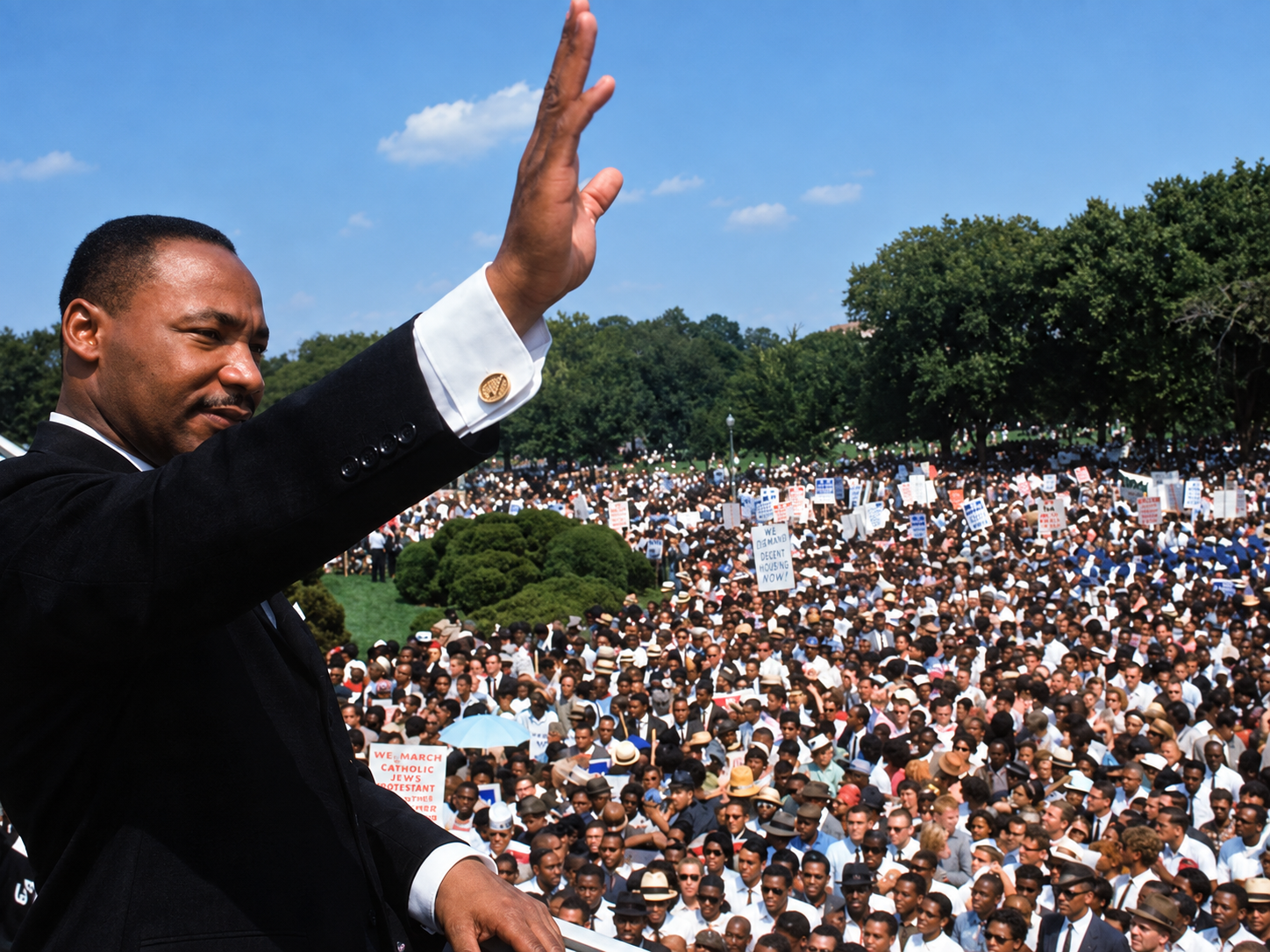

In 1990, the political scientist Juan José Linz argued that American democracy’s unusual stability was not a product of institutional genius but of exclusion – specifically, the exclusion of Black Americans from political life. Once that exclusion ended, the conditions for deep polarisation were created. The Civil Rights Movement was not just a moral turning point; it was the moment American democracy became complete, and in becoming complete, became fragile.
The United States’ internal political order after the Second World War had become one of stability and unity. The Great Depression had ended because of war production causing a major economic boom, and the Democrats held control of the presidency for 20 consecutive years, producing a massive leftward shift across American politics. FDR had built his New Deal coalition around groups of voters that, besides their poverty during the Depression, had very little to do with one another. Although they lived hundreds of miles apart, Black Northerners and white Southerners were, for the first time ever, voting for the same candidate. Despite the massive voter suppression of African Americans taking place in the South, they probably would’ve approved of the candidate their white neighbours put in power.
African American groups like CORE – the Congress of Racial Equality – saw major wins in this period, as they were able to end employment discrimination in the war industries and call attention to their movement. President Truman ordered the desegregation of the armed forces over the course of the Korean War in the early 1950s. As the Republicans started to resurge in the late 1940s, they had a platform much more similar to that of their Democratic counterparts than their previous 1920s laissez-faire style of governance, supporting government intervention in the economy and not dismantling the New Deal. The Civil Rights Movement would turn this fragile unity on its head as the federal government finally took a stand for African Americans and supported them against discrimination, leading to political fragmentation as both parties and voters finally drew their lines in the sand.
The federal government between 1950 and 1980 for the first time truly worked to support the rights of its Black citizens outlined in the Constitution. For most of the 1950s, the president was the Republican Dwight Eisenhower, who ran on being middle-of-the-road – he wasn’t known as a firebrand and his party affiliation hadn’t even been known prior to his announcement that he would run. His term would see major civil rights victories: he passed the first Civil Rights Act since Reconstruction in 1957, and most importantly, his handpicked Chief Justice, Earl Warren, oversaw the 9-0 ruling on Brown v. Board in 1954 which saw segregation deemed unconstitutional in schools. In 1957, he even took the bold step of enforcing this decision, when he sent the National Guard to accompany the Little Rock Nine – nine Black students – to school when the governor took action to stop them from entering. Even though the Republicans were the party of Lincoln and the South was still held by Democrats, FDR and Truman’s early steps towards civil rights made the end of segregation seem to many as an inevitable occurrence with bipartisan backing.
After Eisenhower’s second term, Democrat John F. Kennedy took office in 1960 and was even more supportive of civil rights causes. As seen in the report his brother and Attorney General, Robert Kennedy, sent him in 1963, JFK was continuing Eisenhower’s policy of the federal government actually stepping in to enforce desegregation in the South with regard to public places. Around that time, JFK gave a speech after Alabama Governor George Wallace tried to interfere with desegregation. Kennedy called for a Civil Rights Act to be passed, something that would’ve been controversial at the time as these very Southerners he was battling were, in fact, also Democrats. The giant coalition that made the Democrats go from holding the White House for only twenty of seventy-two years between 1860 and 1932 to twenty years of dominance would prove its undoing.
JFK would not live to see what would become the Civil Rights Act of 1964 pass – he was assassinated in November 1963 – but Lyndon Johnson, his vice president, took up the issue and convinced Congress to pass it in Kennedy’s memory. The Act banned all forms of discrimination or segregation within the US, enforceable by the government. Whereas the Civil Rights Act of 1964 was the culminating piece of legislation of the movement in terms of effects on the daily lives of Black Americans, the Voting Rights Act was the legislation that led to the greatest expansion in political rights, with voter registration almost tripling in Southern states between 1960 and 1966.
The advances made under both Republicans and Democrats for civil rights causes overall led to the creation of a new voting bloc among Black Southerners, and led to white Southerners bearing the cost of their racist policies by finding themselves politically homeless. The culminating result of the Civil Rights Movement was the formation of a new party system where race became the major point of partisan division, with the Democrats becoming the party of civil rights and Republicans becoming the party of its counterreaction.
A growing generational and regional divide in the civil rights movement saw young Black Northerners urging for further action to raise the status of African Americans in US society. This became the Black Power movement. In Stokely Carmichael’s 1966 speech What We Want, the civil rights leader and head of the Student Nonviolent Coordinating Committee (SNCC) argued that African Americans in the urban ghettos were not served by the existing civil rights framework:
“One of the tragedies of the struggle against racism is that up to now there has been no national organisation which could speak to the growing militancy of young black people in the urban ghetto. There has been only a civil rights movement, whose tone of voice was adapted to an audience of liberal whites. It served as a sort of buffer zone between them and angry young blacks. None of its so-called leaders could go into a rioting community and be listened to.”
The late 1960s saw a political awakening for African Americans. Now that they could vote and were voting, the truth of America’s racial caste system revealed itself: the shadow of segregation remained even as its legal enforcement dissipated. 51% of Black Americans in 1963 were impoverished compared to only 15% of white Americans. In almost every metric, African Americans were still worse off. The Democratic Party, whether for cynical or altruistic motives, recognised the need to build a social safety net and the support it would garner amongst Black people, who stood to benefit the most. Lyndon Johnson’s Great Society was this social safety net.
The Kerner Commission – the National Advisory Commission on Civil Disorders, established by President Johnson to investigate the causes of the 1967 race riots – reported that whites were fleeing to the suburbs and gutting the city’s resources and tax base, creating two different, unequal Americas, and bringing to light the growing plight of the many African Americans who simply could not afford to leave. Republicans recognised the reason why whites were fleeing the city – they were afraid of race riots and violent crime, which they believed were perpetuated by African Americans.
In the so-called Long Hot Summer of 1967, over 150 cities saw race riots, marking a sharp turn from the greater focus on peaceful protest by early civil rights leaders. Carmichael’s diagnosis proved accurate. The turn towards violent unrest and prior success of the legal end to segregation made some northern whites tired of Civil Rights protests. As recorded in an interview with Kevin Phillips, a Nixon strategist, they decided to target white voters who were anti Black and afraid of violence: “The more Negroes who register as Democrats in the South, the sooner the Negrophobe whites will quit the Democrats and become Republicans. That’s where the votes are.”
To achieve this goal, Republicans used coded political language – phrases like “Law and Order” and the “Silent Majority” – to signal that they would not be supporting further civil rights causes. Republicans ran on tax cuts that also happened to involve cutting those Great Society programmes that mainly benefited Black Americans. White middle-class voters across the country saw no problem with policies of the sort as they stood to benefit. Those motivated by racial animus understood the implicit message. Thus, the Democrats and Republicans polarised on the issue of race, remaining so to this day.
This is precisely what Linz’s framework predicts. In The Perils of Presidentialism, Linz explained the abnormality of the American presidential system’s stability as a quirk of pre-1960s America. Where nearly every other presidential democracy has seen an early end due to radicalisation and democratic breakdown, the US persisted with its system for nearly 250 years. According to Linz, the exclusion of Black Americans from political life – thereby rendering America an incomplete democracy – meant that there were very few tangible differences between most American voters. The American labour and national movements were never strong enough for Communism or Fascism to become a polarising force, so neither became the cleavage point.
Post-Civil War America saw presidents across party lines absorbing ideas from one another – there is a far greater similarity, for example, between Republican Teddy Roosevelt and Democrat Woodrow Wilson than other Republicans of the same period. Only when Southern Whites and African Americans were both going to the polls were two groups that wanted nothing to do with one another participating in American politics for the first time since the Civil War. In a strange recognition of their obvious wrongdoing, many Southern Whites supported segregation in fear of retaliation from Black Americans if given political power.
In taking the side of either of these two groups, the two major parties set themselves down the path towards the America we see now – splintered, bitter, and polarised, with a particular focus on identity. The individual choices of the Republican Party in particular, to embrace rather than ignore reactionary attitudes towards civil rights, have all but prevented mainstream politics from moving past race. Whether Linz’s claims that a polarised America is an America doomed to fail remains to be seen.