"You Can't, Because You Are a Girl"
The media reinforces gender norms and can also change them, says a Rwandan scholar, who uses radio coverage of the abortion law for minors as an example.
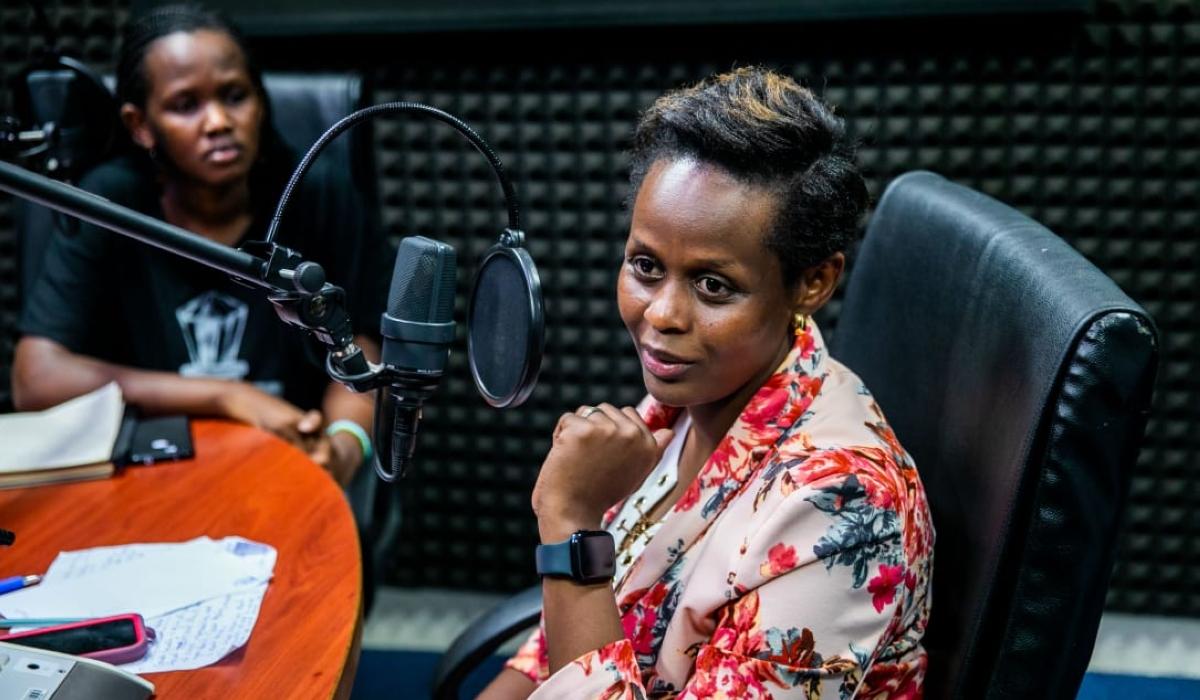

JEANNE d’Arc Mukamana is based at the University of Rwanda, where she studied journalism and communication when it was still the National University of Rwanda. Her PhD examined how media coverage shapes the way Rwandan society understands gender.
The Confluence: How did you first become interested in gender and media as a research focus?
Dr. Mukamana: I was born and grew up in a society where gender disparity [unequal treatment of men and women] is obvious. As a girl, I was always told what I am able to do and what I am not able to do, even before I had tried. It was sealed like that: “you can’t, because you are a girl.” “What if I try?” I could ask, and most of the time the answer would sound like “it is a taboo” or “it is just bad.”
Growing up in that context, children explore, question, and compare with other cultures. A child who starts watching films sees that what is forbidden in our culture is not forbidden in others, and keeps asking why girls and boys are not treated the same way. But the answer was always found in cultural values or religious beliefs, or both.
I cannot trace exactly when I got interested in gender research, because I know myself as a child, or adolescent, who was always questioning issues regarding gender.
Studying journalism and communication at the National University of Rwanda opened another window onto the theories of media and communication, and I began to understand the power of the media over people’s mindsets, and how it can carry new ideas, good or bad. Even my first academic dissertation [her final-year university research project], at the end of my bachelor’s degree, was concerned with women’s consumption of media content and the way media content can sometimes fail to meet women’s tastes. So during my whole academic journey, I always found myself drawn to topics related to gender and media.
The Confluence: What’s the biggest misconception people have about how news coverage shapes the way we see gender in society?
Dr. Mukamana: I can only speak from the knowledge of my own society. I think the biggest misconception is, first, on the side of media houses: the idea that news coverage can always be innocent.
As a journalist, one can say “I covered my story professionally, with all objectivity [reporting the facts without personal bias],” but we know that each piece of media content can have effects in one way or another. So sometimes news producers consider only the newsworthiness of issues regarding gender, and pay little attention to the impact of that coverage on the audience.
On the side of the audience, based on my local context, the misconception is in thinking that what media offers is always good and trustworthy. This has something to do with media literacy [the ability to question and critically judge what the media tells you], which is increasing gradually.
In our society, media in general, especially radio stations, are trusted to the extent that some people may not take the time to judge the content, meaning the audience can end up being passive even when it comes to the coverage of gender issues.
The Confluence: Is there an example of media coverage, in Rwanda or elsewhere, that you think illustrates this particularly well, for better or worse?
Dr. Mukamana: During my PhD, I co-authored a book chapter analysing the coverage of the law allowing abortion for adolescents under 18 in Rwanda [Rwanda’s revised penal code of 2018 added being under 18 to the narrow list of grounds for a legal abortion, and removed the need for a court’s approval].
Based on theories such as Moral Panics [waves of public fear, often amplified by the media, that something threatens a society’s values] and the Public Sphere [the shared space, such as radio phone-ins and talk shows, where citizens debate public issues], it was very obvious that radio coverage of the issue could serve both to inform the audience and to spread panic around the law legalising abortion for minors.
During the interviews, participants from the selected radio stations said their coverage was mainly based on the newsworthiness of the trending issue and the need to inform the public. However, when you analyse it, you find that the impact on society goes far beyond simply informing and discussing the issues affecting it.
The Confluence: What would you say to someone who’s sceptical that media representation really matters, that it just reflects society rather than shaping it?
Dr. Mukamana: Media representation does both. Yes, it shows the realities that exist in a society, but mostly it reinforces them, and reinforcing them makes it harder to change what needs to change.
The media can convince an audience: the more attention it gives an issue, the more weight the public gives it too. But the media can also be an agent of change. Then it is not reinforcing existing behaviour, but inviting the audience to think otherwise. That is how the media shapes the way a society sees itself.
The Confluence: If you could get a general reader to understand one thing about gender and media, what would it be?
Dr. Mukamana: That gender and media is a far more complex field than I ever expected. I always discover new issues to learn, especially because we are dealing with cultural issues, and media carries cultural content, so gender considerations also depend on cultural contexts.
This is why I consider it complex: apart from my own cultural perspective, there are billions of other perspectives, as many as there are societies.