Bent by Hand
History bends toward justice only when people push it there, and the article asks who has been doing the pushing.

COINED by the nineteenth-century abolitionist minister Theodore Parker and popularised by Martin Luther King Jr, the line “The arc of the moral universe is long, but it bends toward justice” speaks of a higher meaning that transcends the bloody and violent days of slavery, as well as the harsh fight for the civil rights of African Americans: that no matter the magnitude of the suffering, no matter how deeply embedded the injustice, a just outcome will, beyond the shadow of a doubt, arrive one day.
But beyond the quote’s deeply stirring effect, is the moral universe and its presupposed arc real? And does it truly bend towards justice? This essay will examine, dissect and argue in favour of four propositions, using the historical method – the discipline’s practice of building an accurate account only out of evidence that can be tested.
Those propositions are these. First, that the moral universe exists as a prescriptive concept: one that tells us how things ought to be rather than describing how they are. Second, that its nature is not spiritual, but rooted in ever-evolving human systems. Third, that its metaphysical shape is indeed an arc. And fourth, that we cannot prove the moral universe has any inherent inclination towards justice.
The Existence of the Moral Universe
The moral universe is not an empirical description of reality – not, that is, a claim about the world that could be checked by observing it – but rather a prescriptive concept. Just like society or law, it is a humanly constructed framework that shapes how we humans think, act and organise ourselves.
That does not make it unreal or unimportant; a currency, a constitution and a border are human constructions too, and every one of them determines what happens to people. What it does mean is that the moral universe has no existence independent of the humans who sustain it, and so any claim about the direction in which it moves must ultimately be a claim about them.
The Nature of the Moral Universe
A popular interpretation of the moral universe, one likely espoused by the deeply religious Theodore Parker and Martin Luther King Jr, is spiritual: the karmic belief that a higher cosmic order ensures good actions beget good outcomes and bad actions beget bad outcomes.
However, the historical method cannot accept this interpretation. Spiritual explanations are untestable, and therefore unverifiable as historical evidence. Furthermore, the spiritual interpretation is teleological: it presupposes that history moves towards a final moral cause, a purpose written in from the very beginning. But history itself is not teleological, as it is an empirical discipline, and so the historical method rejects any retrospective justification of suffering as necessary for an end-goal, advocating instead the analysis of events in their own historical context.
An interpretation more aligned with the historical method is that the moral universe is a living median of humanity’s ever-evolving moral systems, be they codes of law, religious doctrines, cultural norms or much else besides. The moral universe, in this sense, is not a cosmic force from an incomprehensible beyond, but a living, grounded aggregate of such human systems, one that is constantly shaped and reshaped.
The Shape of the Moral Universe
Theodore Parker and Martin Luther King Jr deliberately describe the moral universe as an “arc”, implying opposition to the notion that it moves in a straight line, which would be the most direct and shortest path to a destination. The arc thus implies a much more honest and complex interpretation: that the journey towards a destination will be neither smooth, nor fast, nor direct, but will dip and rise across a long trajectory.
There is a second point of nuance too, since an arc is the shape traced by a thrown object falling, and that carries within it the suggestion that a destination is inevitable. To best demonstrate the moral universe as an arc, then, with its dippings and risings and a general direction and destination chalked down, it is worth turning to the ideas of the German philosopher Georg Wilhelm Friedrich Hegel.
In Phenomenology of Spirit and Lectures on the Philosophy of History, Hegel argues that history is not simply a succession of events in random order, but rather the progressive unfolding of what he called Geist, or Spirit, in which an ultimate form of self-consciousness and freedom is achieved.
The unfolding process starts with a dominant order, known as the thesis, which generates within itself its own contradictions, and those contradictions develop into the negation of the existing order, known as the antithesis. Inevitably, these opposites clash, and thereby give birth to the Hegelian concept of Aufhebung. Meaning sublation in English, Aufhebung refers to the reconciliation of the essential truths of thesis and antithesis, combining and elevating them both to a higher, transcendental synthesis.
Critically, however, this process and the struggles it incurs bear a weighty cost. Hegel describes history as a “slaughter-bench” upon which the happiness of peoples and the wisdom of states are sacrificed. Progress, in other words, may not appear like progress. Instead, it comprises heavy conflict and suffering, which appears as reversal. Meaning only becomes legible after the synthesis has emerged, for only then can we see, retrospectively and in full, what the previous conflict was in service of.
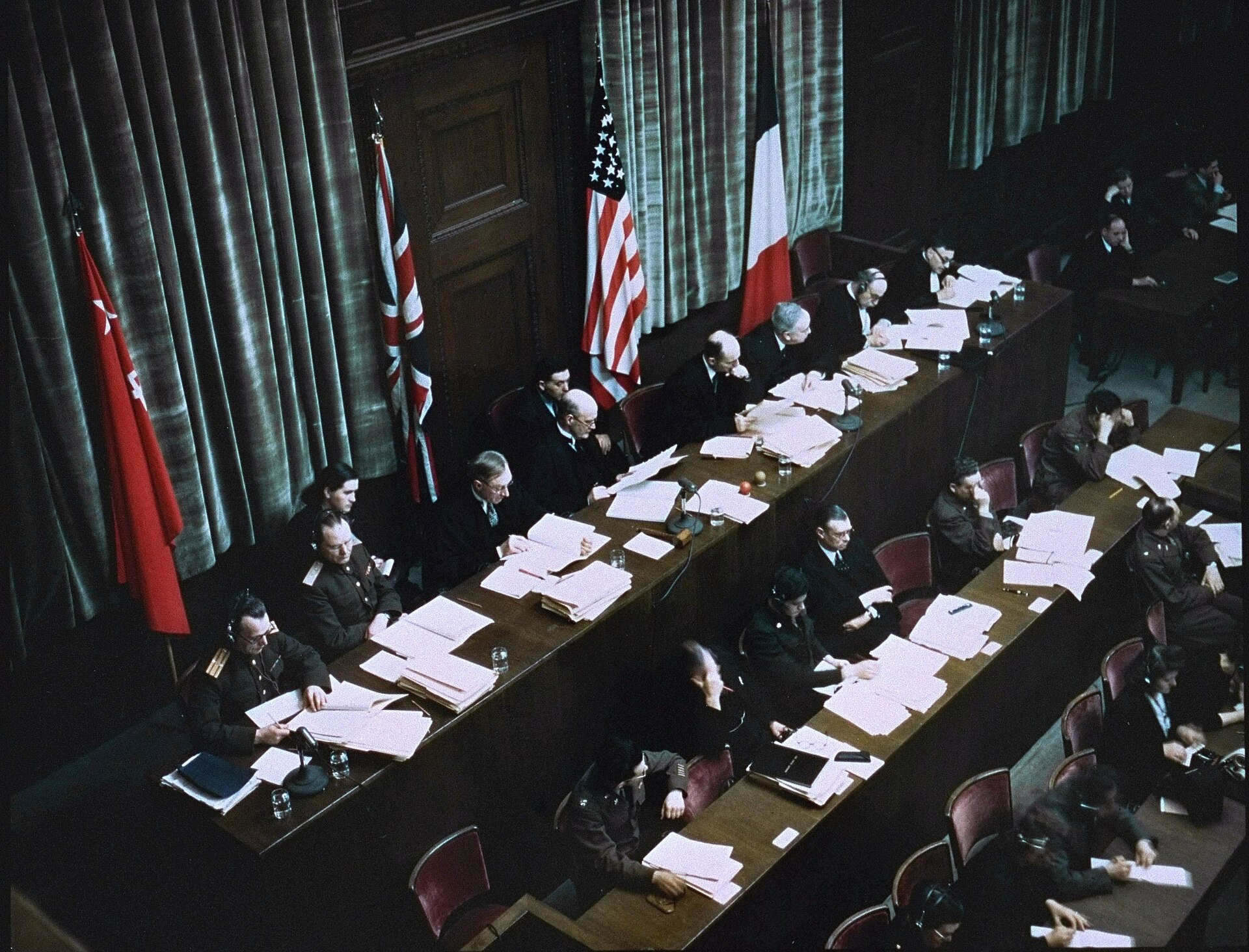
The Second World War and the Nuremberg trials are an illustrative case. The reversal was catastrophic: a descent into industrialised genocide that no prior legal or moral system had prevented. But out of that reversal came a genuine synthesis – an international legal architecture built specifically to try individuals, not just states, for crimes against humanity, something the pre-war order had no mechanism for at all.
That synthesis was higher than what came before it, not merely a restoration of an older order. The arc, understood this way, does not promise that suffering will be redeemed by what follows it. It only describes a pattern in which conflict between systems can, sometimes, produce a system genuinely better than either of its predecessors.
Does It Bend Toward Justice?
Even granting all of the above, the fourth proposition is the hardest to sustain, and this essay does not attempt to sustain more of it than the evidence allows. Justice itself is not a fixed destination visible from any point along the arc; it is defined by the very moral systems the arc is made of, and each generation’s definition of justice contains the exclusions the next generation will identify as its injustice. The abolitionists who coined the phrase could not see the injustices their own society would still come to hold as normal. There is no reason to assume the reverse is not equally true of us.
What can be said, historically rather than spiritually, is this: the direction of the arc is not fixed by any force outside human beings. It is fixed only by what humans do next. Parker’s own 1853 wording is more honest about this than King’s condensation of it – he wrote that his eye reaches but little ways, that he cannot calculate the curve and complete the figure by experience, only that he is sure it bends towards justice, because he can divine it by conscience. That is a statement of moral commitment, not of historical proof. The historical method can confirm the shape without endorsing the promise.
Conclusion
History has a shape, but no destination written into it. That is not a bleak conclusion. It is, if anything, the most demanding form of hope available: if the arc bends towards nothing in particular unless human beings bend it there themselves, then whatever justice the future holds will be a product of what this generation, and every generation after it, actually does.
The arc is long. It is also, in the only sense that matters, bent by hand.